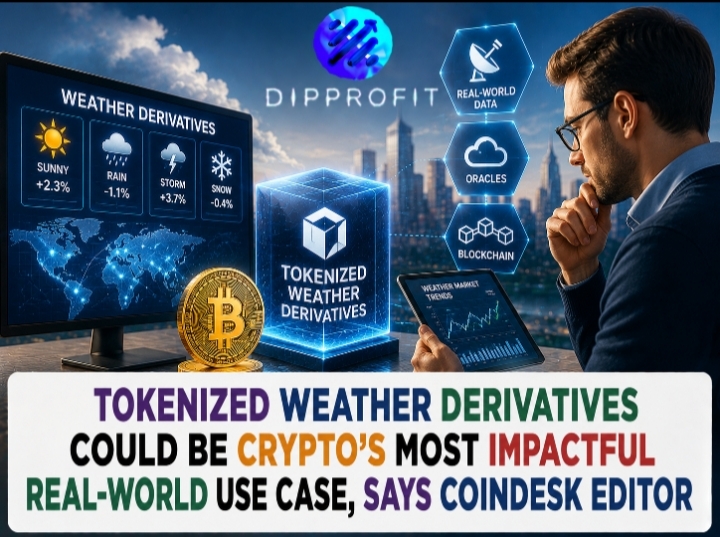

Weather-related financial risks are growing rapidly, yet the traditional derivatives market remains too small, opaque and inaccessible for those most exposed to climate threats. Blockchain-based tokenization could democratize weather risk hedging by automating payouts through smart contracts, reducing counterparty risk and opening climate-risk protection to farmers, small businesses and other non-institutional users who currently lack access to these instruments.
The scale of the problem is staggering. According to Canada’s former Prime Minister Mark Carney, weather-related loss events have tripled since the 1980s, with inflation-adjusted losses increasing fivefold. The World Meteorological Organization estimates weather-related disasters have caused over $2 trillion in global economic losses in the past decade alone, yet the traditional weather derivatives market has a notional value of only roughly $25 billion.
Weather derivatives are financial instruments designed to pay out when specific climate conditions cross predetermined thresholds. A utility company might purchase a contract that pays if winter temperatures stay unusually warm, reducing heating demand and revenue. An airline could hedge against flight cancellations caused by storms. A farmer in India might protect against a failed monsoon. These instruments exist precisely because weather represents one of the largest unhedged financial risks in the global economy.
The problem is that the market built to manage this risk is fundamentally broken. Weather derivatives are highly specific, mostly bespoke contracts based on localized risks and frequently short-term, which severely limits secondary trading activity. The market is dominated by large institutions such as energy utilities firms, which account for roughly 40 percent of all contracts, followed by agriculture at 25 percent.
See also: Tokenization Must Move Beyond Hype to Deliver Real Value for Financial Advisors
Main Street, which faces the most significant climate-related financial risk, is effectively left without an avenue to hedge risks. Smallholder farmers, small logistics operators and micro-businesses in climate-vulnerable emerging markets have no practical access to these instruments. The market is too small, too illiquid and too opaque for anyone without institutional resources to navigate. This structural failure means the very market designed to help the world manage climate risk is failing at its core purpose.
Blockchain technology offers a genuine solution to this problem. Smart contracts can automatically trigger payouts when verified weather data crosses a predetermined threshold, bypassing manual processing, disputes, delays and counterparty risk. A farmer in a rain-dependent economy no longer needs a Goldman Sachs relationship to hedge against a failed monsoon. Parametric insurance products built on smart contracts that read verified rainfall data and pay out automatically represent exactly the kind of market that properly prices and distributes climate risk.
Tokenization also addresses the liquidity and accessibility problems that have stunted the traditional market. Fractional ownership allows weather risk to be divided into smaller units, and the resulting composability facilitates integration of weather derivatives with lending protocols, insurance products and yield-generating instruments. Transparency on every trade, every position and every settlement recorded on a public blockchain addresses the opacity that has historically made price discovery poor and participation limited. This follows a pattern seen in related coverage of how tokenization must move beyond hype to deliver real value for financial markets.
See also: Home Invasions Surge as Most Common Crypto Wrench Attack in H1 2026, CertiK Data Shows
The critical challenge is ensuring the data feeding these products is reliable. Getting tamper-proof, real-time weather data onto a blockchain in a form smart contracts can trust represents the oracle problem. However, early efforts are underway to solve this. Kweather, a leading South Korean weather big data platform, and Flare, a data-centric blockchain network, recently signed a letter of intent to bring meteorological datasets including temperature, rainfall and other climate variables onchain. They aim to enable weather finance products for decentralized finance, parametric insurance and climate risk markets.
According to World Bank assessments, climate transition risks pose equally significant threats as physical risks. As the global economy moves toward a lower-carbon economy, changes in policies and technologies could trigger billions in losses from stranded assets that no longer comply with new regulatory frameworks.
Tokenization will not fix climate change itself. But it might fix the market that was supposed to help manage it. In a world where weather risk is only going to grow, that represents a meaningful contribution to global financial stability.
More Reads:
Ethereum ETFs End 5-Day Inflow Streak With $70.6M in Outflows
Polymarket Account Linked to Farage Backer Received $9M in Crypto From Unknown Sources
If you’re reading this, you’re already ahead. Stay there, by joining the…
Dipprofit’s private Telegram community

Discover more from Dipprofit
Subscribe to get the latest posts sent to your email.