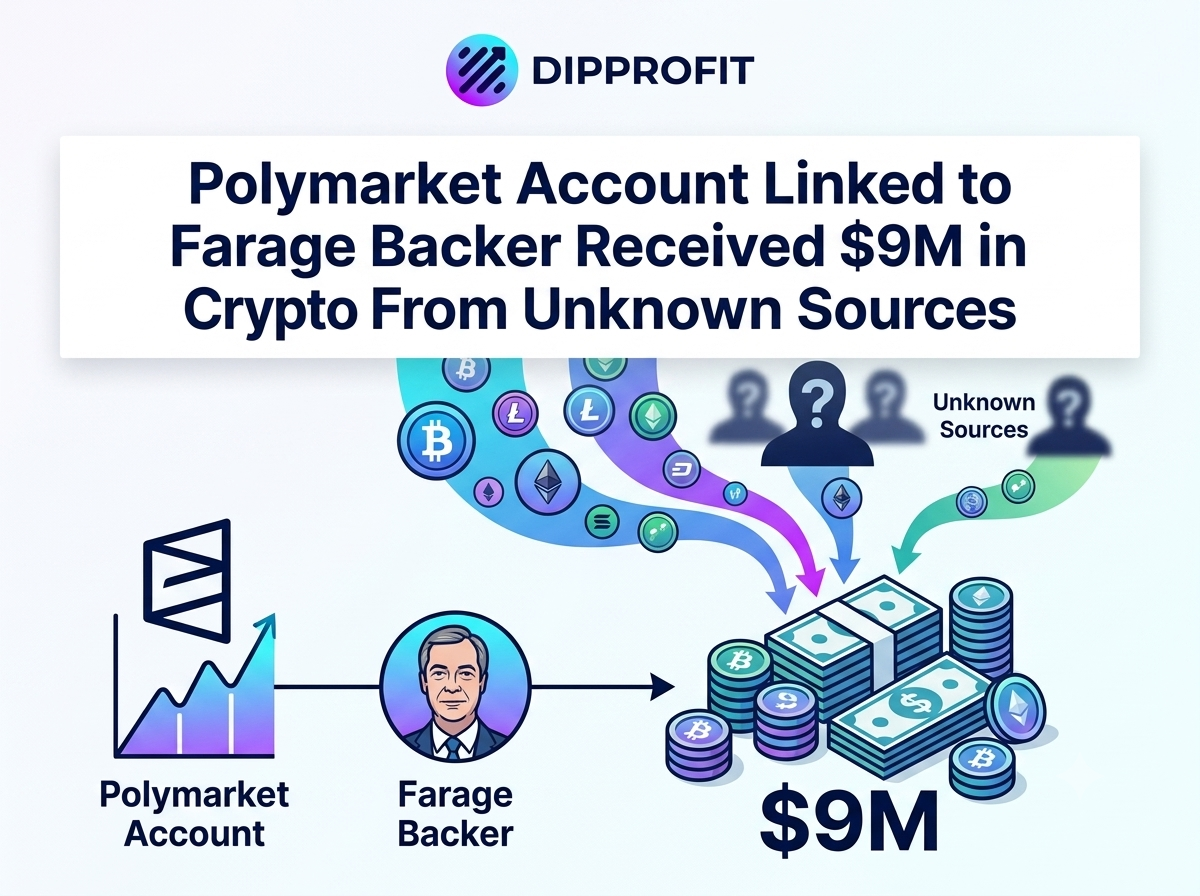

A Polymarket account registered under the name of a prominent backer of British politician Nigel Farage received $9 million in cryptocurrency from unknown sources, according to reporting from the Financial Times. The discovery raises fresh questions about the flow of funds into prediction market platforms and the identities behind major accounts.
Polymarket, one of the largest decentralized prediction markets, allows users to bet on real-world events using cryptocurrency. The platform has grown significantly in recent years, attracting millions in trading volume. However, the revelation about the account’s funding sources highlights ongoing concerns about transparency and regulatory oversight in the crypto betting space.
The account in question was registered under the name of an individual closely associated with Farage, though the Financial Times did not disclose the specific identity. The $9 million in crypto deposits came from wallets that could not be immediately traced to known entities, raising questions about the origin of the funds and whether they comply with anti-money laundering standards.
This follows a pattern seen in related scrutiny over undisclosed gifts from crypto casino operators, which has drawn regulatory attention to Farage’s financial relationships within the digital assets space. The latest discovery adds another layer to ongoing investigations into potential conflicts of interest and financial transparency.
See also: Nigel Farage Faces New Scrutiny Over Undisclosed Gifts From Crypto Casino Operator
Polymarket has faced increasing regulatory pressure in multiple jurisdictions. The platform operates in a legal gray area in many countries, particularly the United States, where the Commodity Futures Trading Commission has raised concerns about unregistered derivatives trading. The platform has previously stated that it complies with applicable laws and works with regulators.
The unknown sources of the $9 million deposit are particularly concerning given the current regulatory environment. Cryptocurrency exchanges and platforms are increasingly required to implement know-your-customer and anti-money laundering procedures. The inability to trace the origin of such a large deposit suggests potential gaps in compliance or oversight.
Polymarket’s user base has expanded dramatically, especially during major political events and elections. The platform allows users from around the world to participate in prediction markets on everything from election outcomes to geopolitical events. This global reach has made it attractive to traders but also raised questions about regulatory jurisdiction and enforcement.
The Financial Times investigation did not specify whether Polymarket itself was aware of the suspicious nature of the deposits or whether the platform had conducted appropriate due diligence. Polymarket has not yet publicly responded to the reporting. The platform’s approach to customer verification and fund source documentation will likely come under increased scrutiny.
See also: Home Invasions Surge as Most Common Crypto Wrench Attack in H1 2026, CertiK Data Shows
Regulatory bodies worldwide are intensifying their focus on cryptocurrency platforms and their compliance procedures. According to Cointelegraph, enforcement actions against crypto platforms have increased significantly as regulators seek to close loopholes in financial oversight. The Polymarket discovery may prompt additional regulatory inquiries into how prediction market platforms vet their users and monitor fund flows.
The incident also raises broader questions about the role of prediction markets in political discourse. These platforms have become increasingly influential in shaping perceptions about election outcomes and political events. The involvement of large, untraced deposits linked to political figures could influence market dynamics and create conflicts of interest.
For Polymarket users and the broader crypto community, the revelation underscores the importance of platform transparency and regulatory compliance. As the industry matures, platforms that fail to implement robust compliance measures may face increased legal and regulatory challenges. The $9 million deposit case serves as a reminder that even decentralized platforms operate within broader legal and financial frameworks.
The investigation is ongoing, and additional details about the account and its activities may emerge in coming weeks. Regulators in multiple jurisdictions are likely monitoring the situation closely. The case highlights the tension between the decentralized nature of cryptocurrency and the regulatory requirements that increasingly apply to platforms facilitating crypto transactions.
More Reads:
Ripple Launches Mint Platform to Expand Institutional Access to RLUSD Stablecoin
Tokenization Must Move Beyond Hype to Deliver Real Value for Financial Advisors
If you’re reading this, you’re already ahead. Stay there, by joining the…
Dipprofit’s private Telegram community

Discover more from Dipprofit
Subscribe to get the latest posts sent to your email.