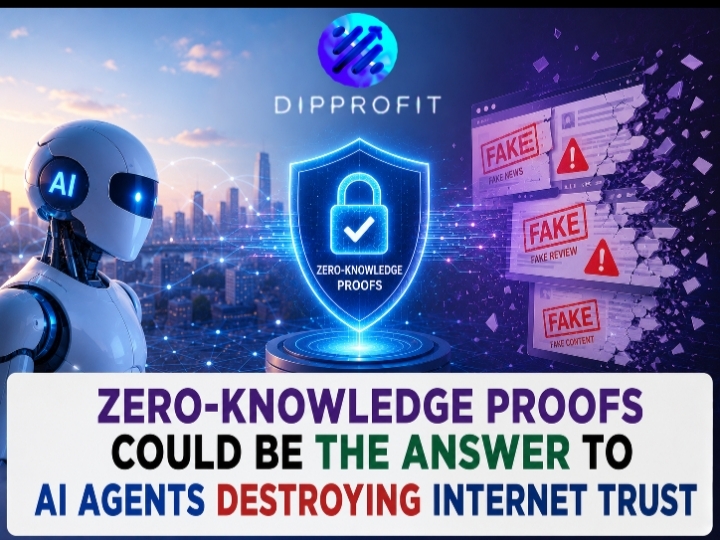

Autonomous AI agents operating at scale pose an existential threat to internet trust, requiring cryptographic proof systems to verify their actions and restore accountability, argues Brian Trunzo, chief growth officer at Succinct Labs.
The era of AI-generated content as a parlor trick has ended. The Iran conflict demonstrated the severity of the problem when synthetic footage of detained American soldiers and fabricated military installations went viral and reached hundreds of millions before verification was possible. The internet as we knew it no longer exists, replaced by an environment where seeing something no longer guarantees belief.
Traditional detection methods have failed to solve this crisis of trust. AI-trained detectors can be broken with basic blur and distortion, dropping accuracy to as low as 4 percent. The fundamental problem mirrors antivirus software’s historical failure against malware: attackers maintain an asymmetric advantage over defenders.
But detection’s inadequacy is almost secondary to a larger problem. AI systems are no longer just generating content. They are acting. Autonomous agents now browse the web, make purchases, publish content, negotiate with other agents, and interact with humans and children who may not know they are communicating with machines. When these systems operate at scale, the failure modes become catastrophic.
An agent trained on subtly poisoned data could make small, plausible errors in medical billing that compound across hospital networks into millions in fraudulent charges. Commerce agents optimizing for margin could systematically exploit pricing vulnerabilities their operators never intended, resulting in billions in losses. These cascading failures leave no audit trail.
See also: OKX, MetaMask, Matter Labs Launch Internet Court for AI Agent Dispute Resolution
When an agent acts, there is no receipt. An agent’s reasoning is not a chronological trace but a single pass through billions of opaque parameters. Outputs are probabilistic, meaning the same question asked twice yields slightly different answers. There is no way to reconstruct a decision built on endlessly changing variables or to audit what the agent was trained on, what instructions it followed, or why it acted as it did.
A recent Stanford report identifies the core tension plainly: the defining challenge of this era is the gap between what AI can do and what society is prepared to govern. Regulation has become a morass, with federal frameworks spanning over 90 recommendations paired with more than 1,000 state-level bills introduced in 2025 alone. Yet these frameworks are designed for a world of chatbots, not autonomous agents that buy, sell, publish, consult, convince and decide.
Content labels and disclosures are insufficient. Once an autonomous agent acts, the damage is already done. This is fundamentally a verification problem, and verification requires proof.
Zero-knowledge cryptography offers a solution by enabling cryptographic, independently verifiable proof. Not a claim or disclosure, but an unalterable guarantee that an AI system did what it claims with the inputs it claims, producing the outputs it claims, without revealing underlying data. First formalized in a 1985 MIT paper, zero-knowledge proofs were initially seen as elegant but theoretical. That changed in 2016 when researchers demonstrated they could verify nuclear warheads without exposing their design. The technology later moved into blockchains, securing billions in digital assets.
For media, zero-knowledge proofs can verify that a photograph was captured by a real device at a verified time and has not been altered, without exposing sensitive information about the photograph or photographer. But media provenance is merely the entry point. The deeper application is AI itself.
At inference, zero-knowledge proofs can verify that a specific model with specific parameters produced a specific output, creating a verifiable receipt for every agent decision. At input, they can attest that training data was not poisoned and came from authorized sources. At output, they can cryptographically bind results to the processes that created them, making every consequential AI decision auditable without revealing trade secrets. This follows a pattern seen in related coverage of AI agent dispute resolution mechanisms exploring how blockchain technology can address accountability questions.
The historical parallel is instructive. In the 1990s, the web had a trust problem. The solution was HTTPS, which required cryptographic proof through certificates signed by recognized authorities. Web1 scaled on math. Web2 scaled on Section 230 liability protections for platforms, enabling the social internet to explode. Web3 attempted to introduce ownership and decentralization but failed to gain traction.
Web3’s instinct was correct: replacing faith with guarantees. But ownership alone was insufficient. The question is not who owns the platform but whether counterparties can trust who and what is acting on it. Tokens were the wrong primitive. Proofs are the right one.
Congress should require that high-risk AI agents handling financial transactions or interacting with minors carry cryptographic proofs of their identity, authorization, and operational constraints, verifiable by any counterparty without revealing proprietary information. The U.S. Department of Commerce, through the National Institute of Standards and Technology, is already exploring zero-knowledge standardization through its Privacy-Enhancing Cryptography initiative, according to NIST.
HTTPS gave the web read capability. Section 230 gave it write capability. Zero-knowledge proofs can give it prove capability. Read, write, prove. This is the framework for restoring trust in an age of autonomous agents.
More Reads:
Institutional Traders Bet $2.5B on Bitcoin Reaching $72K by Month-End Fed Decision
Bitcoin Tests $63K as Long-Term Holders Continue Selling at a Loss
If you’re reading this, you’re already ahead. Stay there, by joining the…
Dipprofit’s private Telegram community

Discover more from Dipprofit
Subscribe to get the latest posts sent to your email.