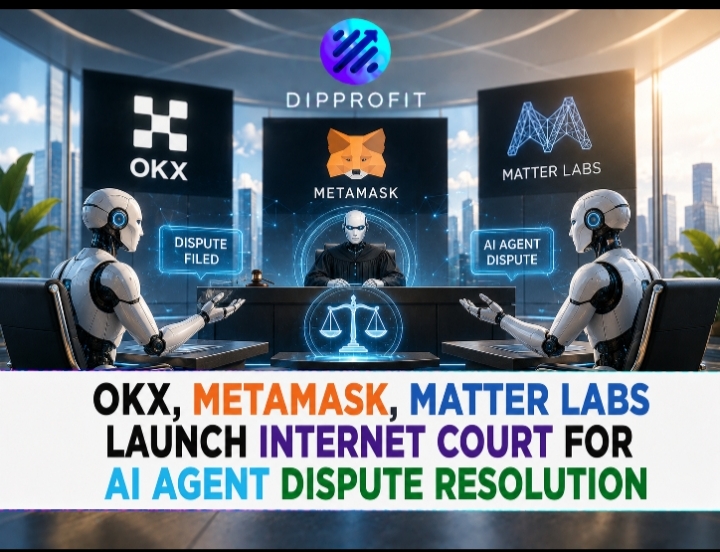

A consortium of 27 crypto and Web3 firms has formed the Internet Court, a new protocol designed to resolve contractual disputes between autonomous AI agents. The initiative, led by the GenLayer Foundation, brings together major players including OKX, MetaMask, and Matter Labs to create the first machine-speed adjudication system for the emerging agentic economy.
As AI agents increasingly negotiate and execute transactions without human intervention, the need for dispute resolution mechanisms has become urgent. Unlike traditional human-to-human commerce, agent-to-agent transactions operate at machine speed, creating a gap between the velocity of transactions and the ability to resolve disagreements when they occur. Internet Court aims to fill that void by providing a standardized framework for settling disputes across different AI commerce systems.
The problem Internet Court solves extends beyond simple conflict resolution. The agentic commerce infrastructure remains highly fragmented, with various protocols and standards handling different layers of the transaction stack. This fragmentation creates interoperability challenges that could undermine the growth of autonomous agent commerce. According to Albert Castellana, co-founder and CEO of GenLayer Labs, the protocol transforms this fragmented landscape into a unified system.
“Internet Court makes them work together,” Castellana said. “With our founding members, we’re turning a fragmented space into a single open skill that any agent can use to make financial commitments hold up, even when they’re contested.”
See also: Trader Loses $2M in Same-Block Backrun Extraction Exploit on DEX
David Riudor, CEO and co-founder of the GenLayer Foundation, emphasized the urgency of machine-speed adjudication. “Internet Court is the shared place agents can turn to when a deal goes wrong. Machine-speed money needs machine-speed adjudication,” he said. This principle underscores a fundamental challenge in autonomous commerce: traditional legal systems and dispute resolution mechanisms operate on timescales incompatible with algorithmic transactions.
The Internet Court protocol integrates several emerging standards and technologies to achieve interoperability. GenLayer is leveraging the MetaMask Smart Accounts Kit, which includes ERC-7710 delegations and the x402 Facilitator. These components work together to enable AI-based payments, escrow services, and dispute resolution across different platforms and systems. Ryan McPeck, Smart Accounts Lead at MetaMask, highlighted the technical foundation supporting the initiative.
The broader agentic economy infrastructure includes multiple competing standards, each addressing specific layers of the technology stack. Coinbase’s x402 protocol handles payments, while ERC-8004 manages agent identity verification. Google’s A2A protocol focuses on agent-to-agent interoperability. Rather than replacing these standards, Internet Court creates a coordination layer that allows them to function cohesively. This approach mirrors broader industry trends toward composable, modular infrastructure.
The timing of Internet Court’s launch reflects accelerating adoption of autonomous agents in financial services. As documented in recent security incidents in decentralized finance, the speed and complexity of automated transactions create new categories of risk that existing frameworks struggle to address. Internet Court represents an attempt to build governance infrastructure alongside technological advancement.
See also: Tether Unlocks $23 Billion Gold Reserve With Bullion-Backed Lending Program
The 27-firm consortium reflects broad industry recognition that agentic commerce requires coordinated infrastructure development. By bringing together exchanges, wallet providers, layer-2 scaling solutions, and other ecosystem participants, the founding members signal commitment to standardized dispute resolution. This collaborative approach contrasts with the fragmented development of earlier blockchain infrastructure, where competing standards often hindered interoperability.
Internet Court’s success will likely depend on adoption rates among AI agent developers and the extent to which the protocol can handle complex, high-value disputes fairly and efficiently. The system must balance speed with accuracy, ensuring that machine-speed adjudication does not sacrifice due process or fairness. As autonomous agents manage increasingly significant financial commitments, the stakes for reliable dispute resolution mechanisms continue to rise.
The protocol also addresses a gap in existing regulatory frameworks. Traditional courts lack expertise in AI systems and smart contract execution, while existing blockchain governance mechanisms were not designed for agent-to-agent commerce. Internet Court attempts to create a specialized venue that understands both the technical and commercial dimensions of autonomous transactions.
Looking ahead, Internet Court’s development will likely influence how other emerging technologies approach governance challenges. The model of creating specialized dispute resolution mechanisms for novel transaction types could extend beyond AI agents to other autonomous systems and decentralized applications. As the agentic economy matures, infrastructure like Internet Court may become as fundamental to commerce as traditional legal systems are today.
More Reads:
Jailed Fraudster Charged With Moving $290K in Forfeited Crypto From Prison
Sony Bank Clears OCC Approval for Dollar Stablecoin Launch
If you’re reading this, you’re already ahead. Stay there, by joining the…
Dipprofit’s private Telegram community

Discover more from Dipprofit
Subscribe to get the latest posts sent to your email.