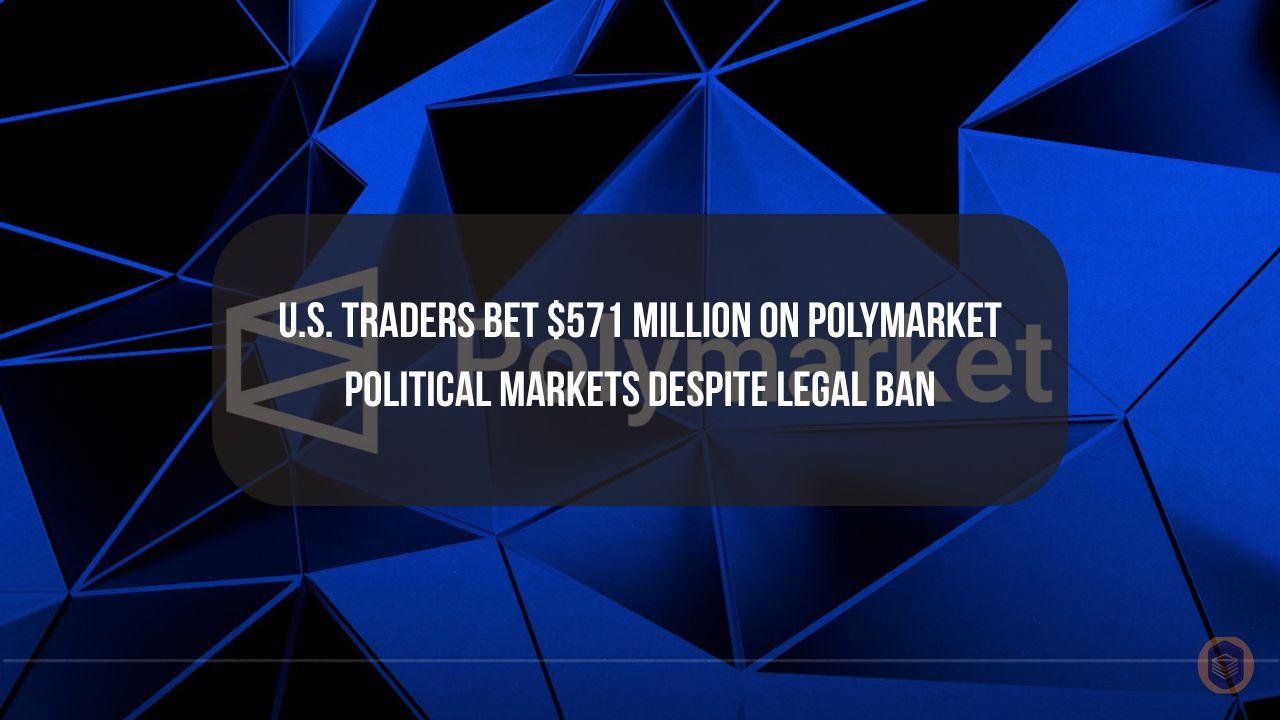

American crypto users have traded over half a billion dollars on Polymarket’s political prediction markets in the past year, making the United States the platform’s largest national market by volume, even though U.S. residents are legally barred from using the service. The finding underscores a growing regulatory challenge as offshore crypto platforms prove difficult to block, and demand for unregulated prediction markets continues to flow beyond U.S. oversight.
According to a new report by onchain analysis firm Allium, U.S.-linked wallets traded $571 million in notional value across Polymarket’s political markets over the trailing 12 months, surpassing Hong Kong’s $422 million and any other country. The data reveals that despite Polymarket’s IP-based geofencing, American traders have found ways around the restrictions using virtual private networks and existing cryptocurrency wallets, bypassing traditional identity verification and payment systems entirely.

Polymarket blocks U.S. users by IP address because it cannot legally serve them under current regulations. However, the platform’s reliance on blockchain infrastructure creates a fundamental enforcement problem. Without a traditional bank account, broker relationship, or centralized payment processor, there is no intermediary for regulators to pressure and no identity check to clear. A VPN combined with an existing crypto wallet is sufficient to circumvent the platform’s geographic restrictions.
Allium’s analysis identifies wallets as U.S.-based through onchain behavioral patterns rather than IP addresses, which is why the VPN masking that fools Polymarket’s initial block does not hide these wallets from the firm’s detection methods. The researchers note that they can only tag approximately 6 percent of Polymarket’s political-market wallets to a specific country, meaning the figures should be interpreted as directional rather than definitive.
The betting patterns reveal something notable about American trader preferences. Geopolitical markets accounted for 46 percent of U.S. notional volume compared to just 36 percent platform-wide, while elections drew only 16 percent from U.S. wallets against 32 percent from the broader user base. This suggests American traders are betting on foreign wars and international conflicts at nearly three times the rate they trade elections, the dominant category for other users.
The markets attracting U.S. capital are precisely those that regulated American venues do not offer. Compliant U.S. platforms like Kalshi and Polymarket’s authorized domestic arm focus primarily on economic data, Federal Reserve rate decisions, and electoral outcomes. The demand for geopolitical and regime-change prediction markets flows instead to the offshore version, which lists markets on wars, ceasefires, and international conflicts. This pattern mirrors broader regulatory concerns documented in recent analysis of crypto regulation challenges.
Among the twelve largest markets for U.S. traders, five involved bets on an Iran war scenario. The single largest market, valued at $20.8 million, was a novelty bet on whether Ukrainian President Volodymyr Zelenskyy would wear a suit. These novelty and geopolitical markets represent the exact categories that U.S. regulators have restricted on domestic platforms.

Interestingly, the data does not support a narrative that American traders possess superior prediction abilities. On resolved markets, U.S. wallets backed the winning outcome 81.9 percent of the time compared to 80.3 percent for all other users, essentially no meaningful edge. Returns on held positions were nearly identical between American and international traders.
See also: Clarity Act Faces Uphill Senate Battle Despite Committee Win, Jefferies Warns
American traders did demonstrate bolder positioning at times, placing 53 percent of their volume on a hypothetical U.S. invasion of Iran when the rest of the market allocated only 26 percent to that outcome. Yet this aggressive positioning did not translate into better returns or more accurate predictions.
Access restrictions have not eliminated U.S. participation in offshore political prediction markets. Instead, the ban has simply moved the largest single political betting market beyond U.S. regulatory oversight while concentrating demand toward exactly the markets American rules restrict. This creates a policy dilemma: whether to bring such markets onshore under regulatory supervision or accept that they will continue operating offshore, visible on the blockchain but beyond government control.
Polymarket did not immediately respond to requests for comment on the Allium findings.
If you’re reading this, you’re already ahead. Stay there, by joining the…
Discover more from Dipprofit
Subscribe to get the latest posts sent to your email.