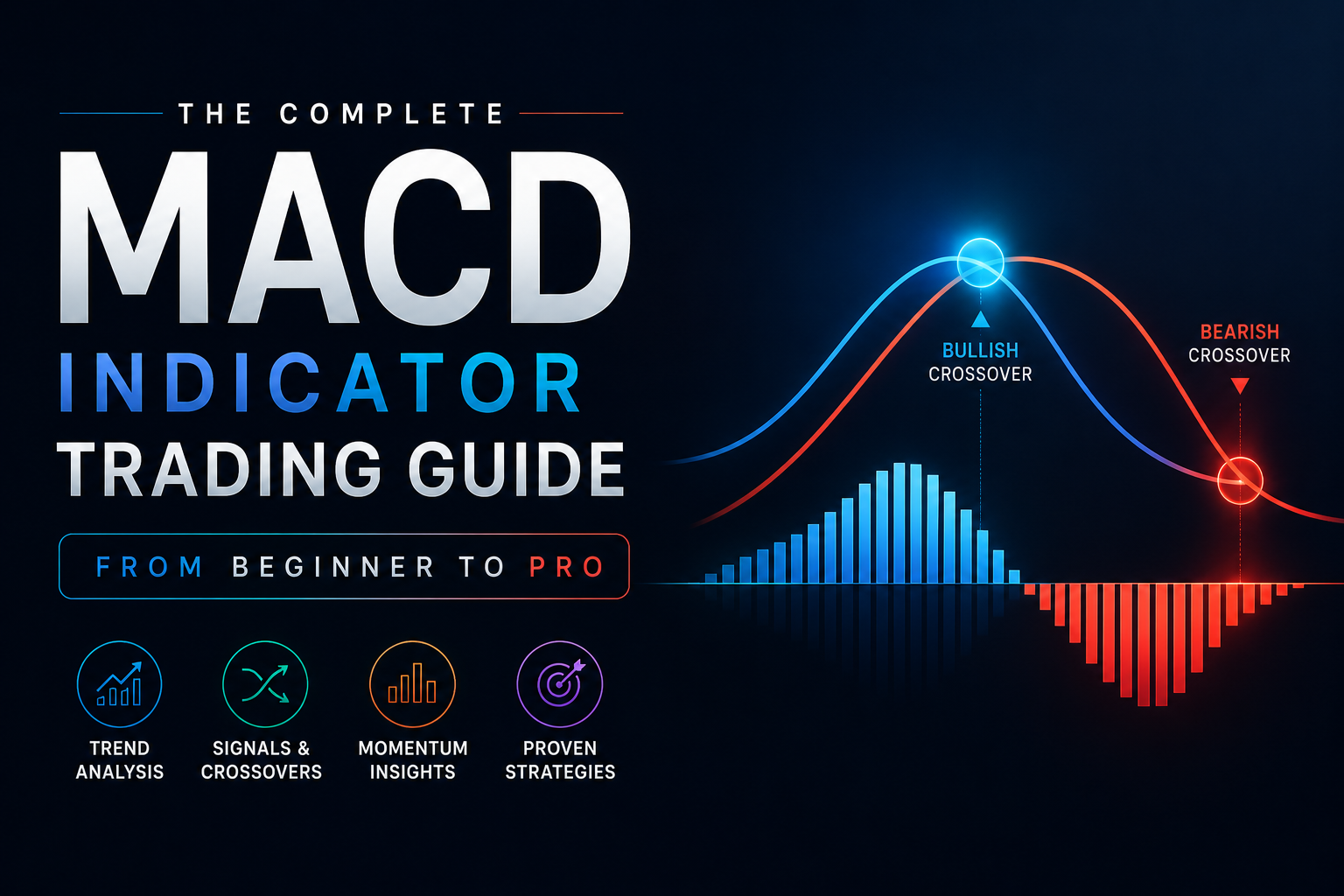

MACD Indicator Trading Guide Introduction.
Walk into any trading room in the world, physical or virtual, and you’ll find one indicator on more screens than almost any other. It’s not RSI. It’s not the Bollinger Bands. It’s the MACD indicator. Every Bloomberg terminal in a hedge fund, every MetaTrader chart on a retail trader’s laptop in Lagos or Lisbon, every TradingView dashboard from New York to Nairobi — the MACD is there.

And yet, for all its popularity, there is a shocking amount of confusion about how it actually works. Traders in the r/Forex and r/Daytrading subreddits post the same frustrated questions month after month: “Why does the MACD give me false signals in a ranging market?” “What is the MACD histogram actually telling me?” “My crossover triggered a buy but price immediately dropped, what happened?”
This guide answers every single one of those questions. From the foundational mathematics to advanced divergence trading, from the EUR/USD daily chart to the XAU/USD 4-hour setup, you’ll finish this article knowing the MACD indicator at a professional level, not because I’ve listed bullet points, but because I’m going to explain it the way a trader with thirty-plus years of experience actually thinks about it.
Let’s get into it.
1. What Is the MACD Indicator? The Real Explanation
Gerald Appel, a technical analyst and money manager in New York, created the Moving Average Convergence Divergence indicator in the late 1970s. He was trying to solve a genuine problem: moving averages gave him useful trend information, but a single moving average told him nothing about momentum, whether the trend was speeding up, slowing down, or about to reverse. His solution was elegant.
Take two exponential moving averages (EMAs) of different lengths, subtract one from the other, and plot the result. That gap, the convergence or divergence between two EMAs, became the MACD line. Appel published the method in 1979, and the rest, as they say, is market history.
So primarily, the MACD indicator answers a single, critically important question: Are the short-term and long-term trend forces moving toward each other (converging) or pulling apart (diverging)?
When price is in a strong uptrend, the short-term average climbs faster than the long-term average. The gap between them widens — they diverge — and the MACD line rises above zero. When momentum weakens, the short-term average starts to decelerate and converges back toward the long-term average. The gap narrows. The MACD line falls back toward zero. This is the language the indicator speaks, and once you understand it at this fundamental level, everything else about MACD becomes intuitive.

— A foundational truth every professional internalizes early
What makes the MACD indicator exceptional among hundreds of available technical tools is that it simultaneously functions as both a trend indicator and a momentum oscillator. Most indicators do one or the other. The Stochastic oscillator is pure momentum. The 200-day moving average is pure trend. The MACD bridges both worlds, and it does so without requiring you to buy a premium subscription or run complex algorithms. It ships standard on every charting platform on Earth.
By June 2026, with over 60 million active users on TradingView alone, the MACD remains the second-most-used indicator globally behind only the basic moving average ahead of RSI, Bollinger Bands, Stochastics, and every other oscillator in existence. That’s not hype. That’s forty-five years of traders validating one man’s formula in live markets across every asset class.
Also Read: Smart Money Concept Trading for Beginners: Learn How Banks Trade
2. The Three Components: MACD Line, Signal Line & Histogram
Understanding what each part of the MACD indicator does, truly understanding it, not just memorizing a definition, is what separates traders who use it profitably from those who don’t. Here’s a thorough breakdown.
〰️ The Signal LineA 9-period EMA applied to the MACD line itself. It smooths out the MACD line, acting as a trigger. Crossovers between the MACD and signal line generate the buy and sell signals most traders know.
The Mathematics Behind the MACD
Let’s be exact about the formulas. Knowing them prevents confusion and helps you understand why the indicator behaves the way it does in different market conditions.
# Step 2: Calculate the MACD Line MACD Line = EMA₁₂ – EMA₂₆
# Step 3: Calculate the Signal Line Signal Line = 9-period EMA of the MACD Line.
# Step 4: Calculate the Histogram Histogram = MACD Line – Signal Line.
The EMA formula itself gives more weight to recent prices than a simple moving average does, which is one reason the MACD indicator responds to price changes faster than SMA-based tools. The multiplier used for an EMA is calculated as 2 ÷ (periods + 1). For the 12-period EMA that’s 2 ÷ 13 ≈ 0.1538, meaning recent prices carry about 15% of the weight. For the slower 26-period EMA the multiplier is roughly 7.4%, so it reacts more slowly to price changes — and that difference in reaction speed is precisely what creates the MACD signal.

Why the MACD Uses EMAs Instead of Simple Moving Averages
This is a question beginners rarely ask but should. A simple moving average (SMA) treats every closing price in its lookback period with equal weight. The close from twenty-five days ago counts the same as yesterday’s close. That feels fair mathematically, but in a live market it creates a problem: when a significant price bar drops out of the calculation window, the average can jump or drop sharply even if recent price action was calm.
The EMA avoids this “drop-off” problem by exponentially weighting recent data more heavily while still accounting for all historical data (the older data just gets progressively smaller weights). The result is an indicator that reacts faster to genuine market changes while remaining smooth enough to filter out random noise, the exact properties you need in a momentum and trend indicator.
3. MACD Settings: Default, Fast & Slow Configurations Explained
The default MACD settings 12, 26, 9 were designed by Appel for daily stock charts in the late 1970s. They’ve become standard because they work remarkably well across a wide range of markets and timeframes. But they’re not sacred. Understanding what each parameter does allows you to intelligently adjust them for your specific trading style.
Common MACD Setting Variations
| Setting (Fast/Slow/Signal) | Trading Style | Pros | Cons |
|---|---|---|---|
| 12 / 26 / 9 (Default) | Swing, Position | Best balance; widely tested | Slightly laggy on short TFs |
| 5 / 13 / 1 | Scalping, Intraday | Very fast reaction | High noise; many false signals |
| 8 / 17 / 9 | Intraday (4H, 1H) | Faster signals with moderate noise | Needs confirmation |
| 19 / 39 / 9 | Position / Weekly | Very few false signals | Late entries; misses fast moves |
| 3 / 10 / 16 | Gerald Appel's original | Very responsive histogram signals | Requires experience to interpret |
4. The MACD Crossover Strategy: Entry Signals & How to Read Them
The MACD crossover is the entry point most traders learn first, and for many it’s the only MACD signal they ever use. It’s worth understanding precisely, because the difference between a high-quality crossover signal and a low-quality one can make or break a strategy.
A bullish MACD crossover occurs when the MACD line crosses above the signal line. This suggests that short-term price momentum is accelerating upward faster than the recent trend has been moving, in plain language, buyers are getting more aggressive. A bearish MACD crossover occurs when the MACD line crosses below the signal line, indicating that sellers are gaining control of momentum.
Not All Crossovers Are Created Equal
This is the first lesson professional traders internalize that most retail traders never do. There are four crossover scenarios, and they carry very different weight:

Most retail traders treat every crossover identically. Professionals filter by zero-line position. A bullish crossover that occurs deep in negative territory (MACD well below zero) means the bears had dominated for a while and bulls are now fighting back that’s a potentially significant reversal. A bullish crossover that occurs just slightly below zero, in a recently uptrending market, is just a minor momentum pullback ending a lower-quality signal that deserves a smaller position size.
5. The Zero Line Cross: The Signal Most Beginners Miss
While MACD-signal crossovers get all the attention, the zero line cross is arguably more important for trend identification. When the MACD line crosses above zero, it means the 12-period EMA has crossed above the 26-period EMA which is the technical definition of a short-term uptrend beginning. When the MACD crosses below zero, a short-term downtrend is in force.
The practical implication is powerful: when the MACD line is above zero, you should favor long trades on signal line crossovers and be skeptical of short signals. When it’s below zero, favor shorts and treat long crossovers cautiously. This single filter dramatically improves crossover accuracy in trending markets by aligning your trades with the prevailing momentum direction.
6. MACD Histogram Deep Dive: Momentum Before the Crossover
Here’s a truth that changed my own trading significantly when I first grasped it fully: the histogram shows you momentum direction and velocity before the crossover happens. Crossovers are, by definition, lagging, they tell you something has already changed. The histogram change can tell you something is about to change.
When histogram bars are positive and growing taller, bullish momentum is accelerating. When they’re positive but getting shorter, bullish momentum is decelerating, a warning that a bearish crossover may be coming. When negative bars start shrinking, bearish momentum is fading, potentially signaling a bullish reversal ahead of the actual crossover signal.
Histogram Divergence: The Early Warning System
Watch for the histogram to make its own divergence pattern with price. If price is making a new high but the histogram peak is lower than the previous peak, bearish momentum divergence on the histogram is in play, this is an early warning, often appearing two to five candles before the MACD line crosses the signal line. Savvy traders use this to position early and place a tighter stop.

7. MACD Divergence: The Most Powerful Signal in Technical Analysis
Ask any trader who has used technical analysis for more than five years what their single most trusted signal is, and a disproportionate number will say “divergence.” MACD divergence is, in my experience across three decades of trading, the single most reliable reversal warning available in technical analysis. Not because it’s infallible, nothing is, but because it quantifies something deeply meaningful: the gap between what price is doing and what underlying momentum is doing.
The concept is simple to state but takes experience to trade well. Regular (classic) divergence signals potential trend reversals. Hidden divergence signals trend continuation. Most beginners learn only the first type. Professionals use both.
Regular Bullish Divergence
Price makes a lower low, but the MACD line (or histogram) makes a higher low. This means sellers are losing control, the new price low wasn’t achieved with as much selling force as the previous low. The bears are exhausted. A reversal to the upside is likely.
Regular Bearish Divergence
Price makes a higher high, but the MACD makes a lower high. Buyers are becoming weaker at each new high, momentum is deteriorating even as price continues up. The bulls are losing conviction. A reversal to the downside is likely.
Hidden Bullish Divergence
Price makes a higher low (typical in a healthy pullback during an uptrend), but the MACD makes a lower low. This is counterintuitive to many, the MACD dipped deeper than expected, yet price held higher. This signals that the pullback is shallow relative to the broader uptrend’s momentum and that the uptrend should resume. Hidden bullish divergence is a powerful continuation signal.
Hidden Bearish Divergence
Price makes a lower high (during a downtrend bounce), but the MACD makes a higher high. The bounce in the MACD exceeded what price suggests, meaning the bounce is more a technical relief than a genuine reversal. The downtrend is likely to continue.

8. Pain Points Answered: The 8 Biggest MACD Confusions
I spent a considerable amount of time going through some reddit forums and communities such as r/Forex, r/Daytrading, r/algotrading, and r/stocks to catalog the most common MACD questions and frustrations. Here are the eight most significant ones and the real answers.
The fix is to use a trend filter before taking any MACD signal. The simplest version: only take MACD crossover signals when price is on the correct side of the 200-period moving average. If price is above the 200 MA, only take bullish crossovers. Below the 200 MA, only take bearish crossovers. You will take fewer trades, and a meaningfully higher percentage of them will be winners.
Professional approach: wait for the crossover to be confirmed by the close of the candle, then enter on the next candle’s open. Or, use the crossover as an alert that momentum has shifted and then wait for a price action pullback to an area of support before entering. This way you’re trading the trend in momentum’s direction, but at a better price, with a tighter stop.
The histogram shows you the velocity of change. When histogram bars are growing, the gap between the two lines is expanding, momentum is accelerating. When they’re shrinking, the gap is closing, momentum is slowing. This matters because the histogram can start shrinking and warn you of an impending crossover while the MACD line is still above the signal line. That’s information you can act on before the official crossover signal arrives.
Using the histogram for divergence gives you an earlier signal, the histogram often shows divergence before the MACD line does because it’s measuring the rate of change. For beginners: start with the MACD line for divergence as it’s cleaner and less prone to visual noise. As you gain experience, incorporate histogram divergence for earlier entries on high-conviction setups.
Common scalping MACD settings in active use as of 2026 include 5/13/1 (very fast, aggressive), 8/21/5 (moderate), and 3/10/16 (Appel’s original, which actually works surprisingly well on intraday charts). The key rule: faster settings require stricter confirmation criteria, not looser ones. If you’re running a 5/13/1 MACD, make sure every signal also has price action confirmation and a clear support/resistance level nearby.
If price is making higher lows in an uptrend and MACD makes lower lows, that’s hidden bullish divergence, a continuation of the uptrend. Memory tip: “hidden” divergence is what you find when you look beneath the obvious trend it’s subtly telling you the trend is still healthy.
The MACD tells you about momentum. It does not tell you about value, supply/demand zones, or risk-reward. You need those other inputs to trade well. The traders who profit consistently from MACD are using it as a key component in a fuller system, not as a standalone oracle.
Green bars while price falls can appear during a divergence setup where price is making new lows but the MACD is making higher lows (bullish divergence). It’s an early warning that the selling pressure is weakening, not a confirmation that the bottom is in. Wait for a crossover of the MACD line above the signal line, or a break of a key price structure level, before acting on it.
9. The Complete MACD Trading Strategy: Step-by-Step System
Theory without application is worthless. Here is a complete, executable MACD trading strategy that integrates everything we’ve covered. This is the kind of structured approach professional traders use, not “I see a crossover, I buy.”
The Multi-Confirmation MACD Strategy
1. Identify the Higher Timeframe Trend
Go to a timeframe two to three levels above where you plan to trade. If you’re trading on the 1-hour chart, check the daily chart. Identify whether MACD is above or below zero. This determines your bias. Only look for longs if the daily MACD is above zero (or at least trending up toward it). Only look for shorts if daily MACD is below zero.
2. Apply the 200 EMA Filter
On your trading timeframe, mark the 200-period EMA. If price is above it, you’re in a long-bias environment. Below it, short-bias. This filter alone eliminates a large percentage of false signals that generate losses in ranging periods.
3. Watch for Divergence Near Key Levels
Identify significant support and resistance levels, swing highs and lows, or Fibonacci retracement zones. Watch for MACD divergence at these levels. A bullish divergence at a major support zone, in an overall uptrend, is a very high-probability setup. This is where the trade begins to form.
4. Wait for the MACD Indicator Crossover Confirmation
Once divergence is spotted and the key level is being tested, wait for the MACD line to cross the signal line in the direction of your bias. This is your official entry trigger. Do not enter on divergence alone, wait for the crossover to confirm that momentum has actually shifted.
5. Enter on the Candle Close After the Cross
Do not enter the moment the crossover looks like it might be forming. Wait for the candle to close with the cross confirmed. Enter at the open of the next candle. This reduces false crossovers where the lines appear to cross intra-candle but then separate again before the close.
6. Place Your Stop Loss Below the Divergence Low (for Longs)
For a bullish setup, the stop goes below the recent swing low where the divergence occurred, below the level that formed the “higher low” on the MACD or the “lower low” on price. This stop placement has technical meaning: if price breaks below the divergence structure, your thesis is invalidated.
7. Set Your First Target at the Nearest Resistance / Risk-Reward ≥ 1:2
Identify the next significant resistance level. Your first partial target should be there. If the risk-reward ratio (distance to stop versus distance to target) is less than 1:2, the trade doesn’t meet minimum professional criteria — do not take it. Better to wait for a setup where the math works in your favor.
8. Trail Your Stop After First Target Is Hit
Once price reaches your first target and you’ve taken partial profits, move your stop to breakeven on the remaining position. Then trail it using the MACD: exit the full position when the MACD line crosses back below (or above, for shorts) the signal line. This keeps you in winning trends longer while locking in minimum profitability.
10. Combining the MACD Indicator with Other Indicators
The MACD indicator is excellent in combination with tools that cover its weaknesses. Its main weakness is that it doesn’t identify overbought/oversold levels well, and it doesn’t pinpoint exact price structure. The best complementary tools address these gaps directly.
| Indicator Partner | What It Adds | How to Combine | Synergy Rating |
|---|---|---|---|
| RSI (14) | Overbought/oversold levels; RSI divergence confirmation | Use RSI divergence + MACD divergence simultaneously for ultra-high confidence setups | Excellent ★★★★★ |
| 200 EMA | Long-term trend filter | Only take MACD signals in the direction price is relative to the 200 EMA | Excellent ★★★★★ |
| Bollinger Bands | Volatility and price extremes | MACD crossover near lower band = very strong bullish setup | Very Good ★★★★☆ |
| Volume | Confirms momentum with actual trading activity | MACD bullish cross + volume spike = high-confidence entry | Very Good ★★★★☆ |
| Fibonacci Retracements | Price structure and key levels | Look for MACD divergence at 61.8% or 78.6% retracement levels | Good ★★★☆☆ |
| ATR (Average True Range) | Volatility for stop placement | Place stops at 1.5–2x ATR below the MACD divergence low | Good ★★★☆☆ |
| Stochastic Oscillator | Short-term overbought/oversold cycles | Avoid if Stochastic is overbought when MACD gives a buy signal | Moderate ★★★☆☆ |
11. Live EUR/USD Chart Analysis: MACD Indicator in Action (June 2026)
Let’s leave theory behind and look at a real market situation. As of June 19, 2026, EUR/USD is trading near the 1.1480–1.1500 zone on the daily chart, having pulled back from a 2026 high around 1.1820 reached in the spring. The MACD on the daily chart is in negative territory with a reading near -0.0056 on the signal line, indicating the current downward correction. The RSI is hovering around 37–42, not yet at classic oversold extremes but showing the correction has real selling pressure.
Here’s what the MACD was telling us through the key phases of 2026 EUR/USD price action:

Chart 1: EUR/USD Daily MACD Analysis January to June 2026. Note the bearish divergence on the MACD histogram in April 2026 (histogram peaks lower than March peak while price reached a new high at 1.1820). This was the warning shot before the May/June correction down toward 1.1480. The MACD line crossed below the signal line in early May, confirming the bearish shift. As of June 2026, MACD remains below zero at approximately -0.0056, indicating the correction is technically still in force.
Reading the EUR/USD MACD Indicator Right Now (June 19, 2026)
Let’s translate the current data into actionable context. EUR/USD is trading near 1.1490 on June 19, 2026. The daily MACD is -0.0056 on the signal line, firmly in negative territory. The RSI sits around 38–42. The 200 EMA is approximately at 1.1670.
What does this mean for traders? Three key observations: First, the MACD is below zero, so the primary momentum bias is bearish on this timeframe — shorts remain directionally favored. Second, the histogram bars are visibly shrinking (the negative bars are getting smaller), suggesting the bearish momentum may be decelerating not reversing, but the selling pressure is easing. Third, the 1.1560–1.1580 zone has served as support and is being watched closely; if MACD crosses back above its signal line from negative territory near this support level, that would qualify as a high-quality bullish setup based on our framework above.

12. Live XAU/USD Chart Analysis: MACD Indicator on Gold (June 2026)
Gold has had one of the most extraordinary years in recent memory. XAU/USD hit an all-time high of $5,602 on January 29, 2026, driven by geopolitical tensions, persistent dollar weakness in the first half of the year, and central bank buying. As of June 19, 2026, gold is trading around $4,147–$4,153, having corrected significantly from those ATH levels. The MACD on XAU/USD tells a fascinating story of this move.
 Chart 2: XAU/USD Daily — MACD Analysis January–June 2026. The MACD gave clear bearish signals ahead of the massive correction from the $5,602 ATH. The histogram peak in early January was actually lower than the momentum of the rally suggested (bearish divergence), the MACD line crossed below the signal line in February as price began the initial sell-off, and a second bearish crossover in April confirmed the continuation of the downtrend. As of June 19, 2026, the MACD stands at approximately -31.74, still firmly in negative territory, confirming the sell-side momentum remains dominant on the daily chart.
What the XAU/USD MACD Indicator Is Telling You Right Now
The current MACD reading of approximately -31.74 on XAU/USD is significant. That’s a substantial negative reading, meaning the 12-period EMA is well below the 26-period EMA, the medium-term downtrend is intact. However, the histogram bars have been shrinking for the past two to three weeks, which is a pattern worth watching. Gold is down roughly 26% from its January ATH. At some point and the histogram shrinkage is an early signal that the selling exhaustion will create a base from which a meaningful recovery can develop.
What would make a high-quality MACD long setup on XAU/USD? A daily MACD crossover back above the signal line, ideally occurring near the $4,000–$4,100 area (a clear psychological and structural level), with RSI simultaneously crossing above 40 from oversold territory. Until that happens, the MACD is unambiguous: the momentum bias on gold is bearish.

13. The MACD Indicator Across Timeframes: Which Works Best?
The MACD works on every timeframe, but its signal quality and what it reveals about the market varies dramatically depending on which timeframe you’re analyzing. Here’s a practical breakdown:
| Timeframe | Signal Quality | Best Use Case | Typical Hold Duration |
|---|---|---|---|
| Monthly / Weekly | Highest quality | Long-term trend identification; position trading | Weeks to months |
| Daily | Excellent | Swing trading; best balance of quality and opportunity | 3–15 days |
| 4-Hour | Very Good | Swing and intraday; excellent for forex MACD strategy | 1–5 days |
| 1-Hour | Good | Intraday swing trades; needs daily confirmation | Hours to 1–2 days |
| 15-Minute | Moderate | Short-term trading with strict filters | 30 minutes to several hours |
| 5-Minute / 1-Minute | Low (noisy) | Scalping only; requires faster settings (5/13) and strong price action | Minutes |
Professional advice: if you’re relatively new to MACD trading, start with the daily chart and only the daily chart until you understand signal quality and filtering deeply. The temptation to go lower is real, lower timeframes mean more setups and the illusion of more opportunities. What they actually mean is more noise, more false signals, and more decisions per day — all of which reduce quality and increase cognitive load. Master the daily chart first.
14. MACD Indicator Limitations: When NOT to Use It
The greatest disservice you can do to yourself as a MACD trader is to treat it as an infallible signal machine. There are specific market conditions where the MACD performs poorly, and knowing them protects your capital.
Additionally, remember that the MACD is fundamentally a lagging indicator, it describes what has already happened, not what is about to happen. Divergence is its most forward-looking function, but even divergence can persist for many candles before a reversal materializes. Always treat the MACD as confirmation of a trading thesis, not as the original source of that thesis.
15. Pro-Level MACD Techniques: What Professionals Actually Do
Multiple Timeframe MACD Analysis
One of the most powerful professional applications of the MACD indicator is analyzing it across multiple timeframes simultaneously. The standard approach is to check the weekly or daily chart for the bigger directional bias (is MACD above or below zero? Has it recently crossed?), then drop to the 4-hour or 1-hour chart to time entries. This creates a situation where your entry-level signals align with the larger momentum context — a far more powerful combination than any single-timeframe approach.
The MACD Threshold Technique
Rather than acting on any crossover signal, professional traders often set threshold levels for the MACD’s position at the time of the crossover. For example: only take a bullish crossover if the MACD line is more than 0.0020 below zero (for EUR/USD) at the time of the cross. This ensures the signal comes from a point of genuine momentum exhaustion rather than a minor fluctuation near the zero line.
MACD Slope Analysis
Beyond looking at where the MACD is, experienced traders look at how fast it’s moving. A MACD line that’s rapidly rising at a steep angle indicates explosive momentum, the kind that often leads to swift, profitable trend moves. A MACD that’s creeping higher at a shallow angle suggests weak, potentially unreliable momentum. Slope analysis doesn’t require any additional tool, you simply need to observe the angle of the MACD line over the past several candles.
The MACD Double Divergence
This is a high-conviction setup: when you observe MACD divergence on two consecutive timeframes (e.g., both the daily and 4-hour charts showing bullish divergence simultaneously), the probability of a meaningful reversal is substantially higher than divergence on a single timeframe. The convergence of momentum signals across timeframes represents institutional-level confluence that the smart money responds to.
16. MACD Indicator FAQ: Quick Answers to Common Questions
What does MACD stand for? Moving Average Convergence Divergence. The name describes what it measures: whether two moving averages are moving toward each other (converging) or apart (diverging).
Is the MACD Indicator a leading or lagging indicator? It is primarily a lagging indicator, since it’s based on historical price data (exponential moving averages). However, MACD divergence provides a degree of leading signal, as it can warn of momentum shifts before they become visible in price.
What are the best MACD Indicator settings for forex? The default 12/26/9 works extremely well for swing trading on the daily and 4-hour charts. For faster intraday trading, 8/21/5 or 5/13/1 are commonly used by professional forex traders.
Can the MACD Indicator be used for crypto trading? Absolutely. The MACD performs well on cryptocurrency charts — particularly on daily and 4-hour timeframes — because crypto markets often exhibit extended trending behavior that suits momentum indicators. Crypto’s higher volatility does mean you should be more selective with crossover signals and rely more heavily on divergence setups than in forex or stocks.
What is a MACD death cross? A “death cross” in the context of MACD refers to the MACD line crossing below the signal line, generating a bearish signal. It’s different from the traditional death cross (50-day SMA crossing below 200-day SMA), so be careful about terminology. In MACD specifically, the bearish crossover is sometimes called a negative crossover or a MACD sell signal.
How reliable is MACD divergence? Properly applied at key price levels, in the context of the higher-timeframe trend, with confirmation from a crossover, MACD divergence is among the highest-probability setups in technical analysis. Without proper filtering, it generates many false signals. The technique requires experience to apply well. Start by only acting on divergence when it coincides with major support or resistance levels.
Does MACD work in all markets? The MACD works across forex, stocks, commodities, crypto, indices, and bonds — any market that can be charted with price bars. Its effectiveness is most consistent in trending markets. In range-bound, choppy markets, all crossover-based signals from MACD degrade significantly.
Should I use the MACD histogram or the MACD line? Use both, for different purposes. The histogram is best for detecting momentum shifts early (including divergence signals). The MACD line crossing the signal line is the official entry trigger. Think of the histogram as your radar and the crossover as your confirmed signal.
Closing Thoughts: Making the MACD Indicator Work for You
The MACD indicator has survived and thrived for nearly five decades because it quantifies something real and fundamental about markets: the relationship between short-term and long-term momentum. That is not going to change. Markets will continue to trend, momentum will continue to shift, and the MACD will continue to measure those shifts cleanly and clearly.
But the indicator alone is not a strategy. The traders who make consistent money with MACD are the ones who combine it with a clear trend bias from a higher timeframe, meaningful price structure levels, proper confirmation requirements before entry, and rigid risk management. They don’t treat every crossover as a trade. They wait for the setups where multiple factors converge, where the MACD is confirming what price action and key levels are already suggesting.
Start with the daily chart. Learn to read the histogram before the crossover. Train your eye to spot divergence at key levels. Add the 200 EMA as your primary trend filter. Risk no more than 1–2% of your account per trade. Do these things consistently, and the MACD indicator will become one of the most powerful tools in your trading arsenal.
The EUR/USD and XAU/USD examples in this guide are real, current snapshots as of June 2026, not hypothetical back-tested setups. The MACD on the daily EUR/USD is negative at -0.0056 and watching for a potential reversal setup near 1.1480–1.1560. The MACD on gold is aggressively negative at -31.74, confirming the ongoing correction from the January 2026 all-time high of $5,602. These are live markets telling live stories, and the MACD is reading every chapter.
You can also join our Telegram community where you can learn all you want to know about the cryptocurrency space, defi, web3, and airdrop opportunities and also have access to live AMA sessions from time to time, then click the button below to join Dipprofit Telegram Community For Free Now.
Discover more from Dipprofit
Subscribe to get the latest posts sent to your email.