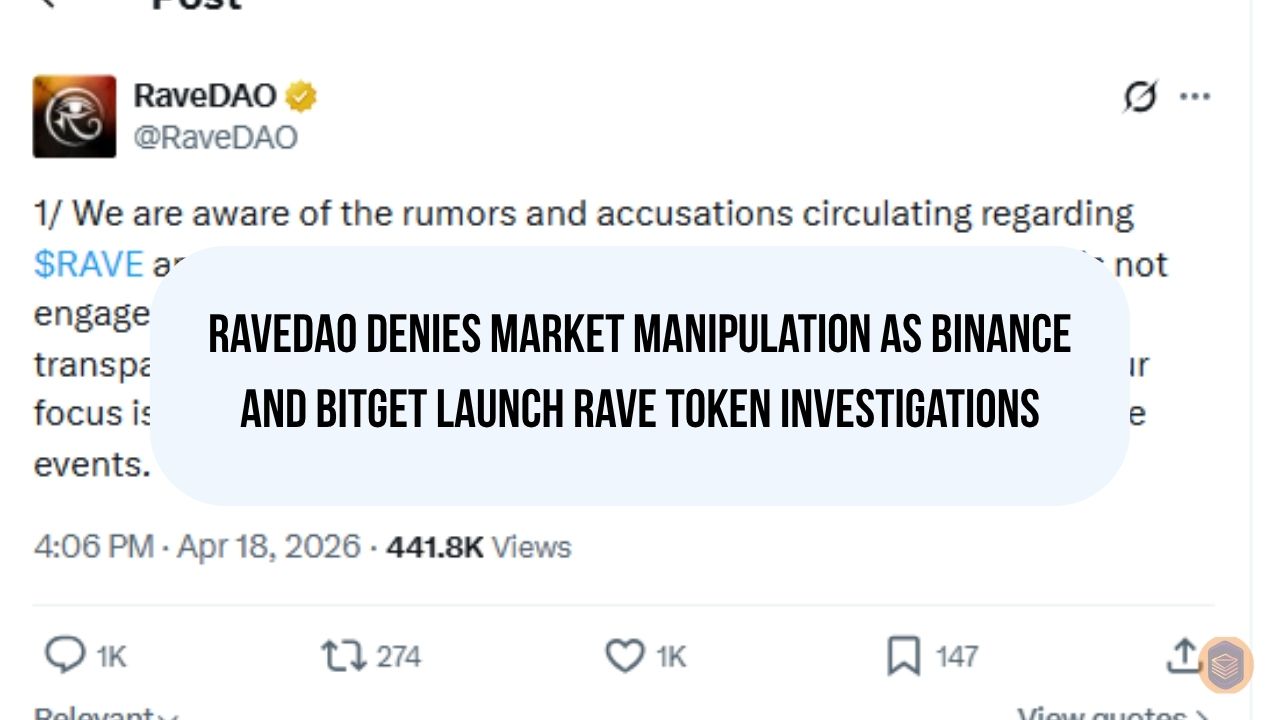

RaveDAO has denied any involvement in alleged market manipulation following a dramatic surge and collapse of its RAVE token that saw the cryptocurrency climb from $0.25 to nearly $28 before crashing more than 80%, prompting investigations by major exchanges Binance and Bitget.
The Web3 entertainment project stated in an X post that it was “not engaged in, nor responsible for, recent price action,” as scrutiny intensified over suspicious trading patterns that raised red flags across the cryptocurrency industry.

The denial comes amid mounting allegations from prominent onchain investigator ZachXBT, who accused the project of orchestrating a pump-and-dump scheme. The investigator pointed to concentrated token holdings and suspicious exchange flows as evidence of potential manipulation.
ZachXBT claimed that more than 90% of the RAVE token supply may be controlled by insiders, calling on exchanges to take immediate action against what he characterized as coordinated market manipulation.
Both Binance and Bitget quickly responded to the allegations by launching formal investigations into RAVE trading activity. “We’re looking into it,” Binance CEO Richard Teng wrote in response to the concerns raised on social media.
Bitget CEO Gracy Chen confirmed her exchange had also taken action, stating that the platform had “started investigating” the suspicious trading patterns surrounding the RAVE token.
The investigations highlight ongoing concerns about market manipulation in the cryptocurrency space, particularly around tokens with concentrated ownership structures that can be vulnerable to coordinated price movements.
See also: Bitcoin’s Quantum Threat is More Social Than Technical Problem, Says Grayscale

In its defense, RaveDAO outlined plans to sell portions of unlocked tokens to fund operational expenses, marketing initiatives and new hiring. The team said it is exploring “price-triggered or performance-triggered locks” to better align incentives between the project and token holders.
“Building a movement requires resources,” the project wrote, adding that it aims to conduct its operations “sustainably and transparently” going forward.
RaveDAO operates as a Web3-based entertainment project that combines electronic music events with blockchain technology. The project aims to onboard users into cryptocurrency through real-world experiences such as festivals and parties.
The platform functions as a decentralized community where event attendees receive non-fungible tokens (NFTs) for participation. Its RAVE token serves multiple functions including governance rights, ticketing systems and access privileges to exclusive events.
At the time of writing, RAVE is trading at $1.36, representing a 94.95% decline over the past 24 hours, according to data from CoinMarketCap. The dramatic price collapse has left many investors facing significant losses.
The incident adds to a growing list of concerning market events in the cryptocurrency sector. More than a dozen decentralized finance (DeFi) protocols and crypto firms have been hit by exploits in just over two weeks starting April 1.
The wave of attacks began with the massive $280 million Drift Protocol hack and has since affected numerous other projects. Victims include CoW Swap, Hyperbridge, Bybit, Silo Finance, Aethir and Rhea Finance, along with various exchanges and liquidity pools across multiple blockchain networks.
The exploits have ranged from smart contract vulnerabilities and oracle manipulation to access control failures and liquidity pool compromises. Security experts have warned that the frequency and sophistication of attacks appears to be increasing.
The RAVE token controversy underscores the challenges facing cryptocurrency projects in maintaining market integrity and investor confidence. As exchanges and regulators increase scrutiny of suspicious trading activity, projects face growing pressure to demonstrate transparent operations and fair token distribution practices.
The outcome of the Binance and Bitget investigations could have significant implications for how exchanges handle similar cases in the future and what standards they apply when evaluating potential market manipulation.
If you’re reading this, you’re already ahead. Stay there, by joining the…
Discover more from Dipprofit
Subscribe to get the latest posts sent to your email.