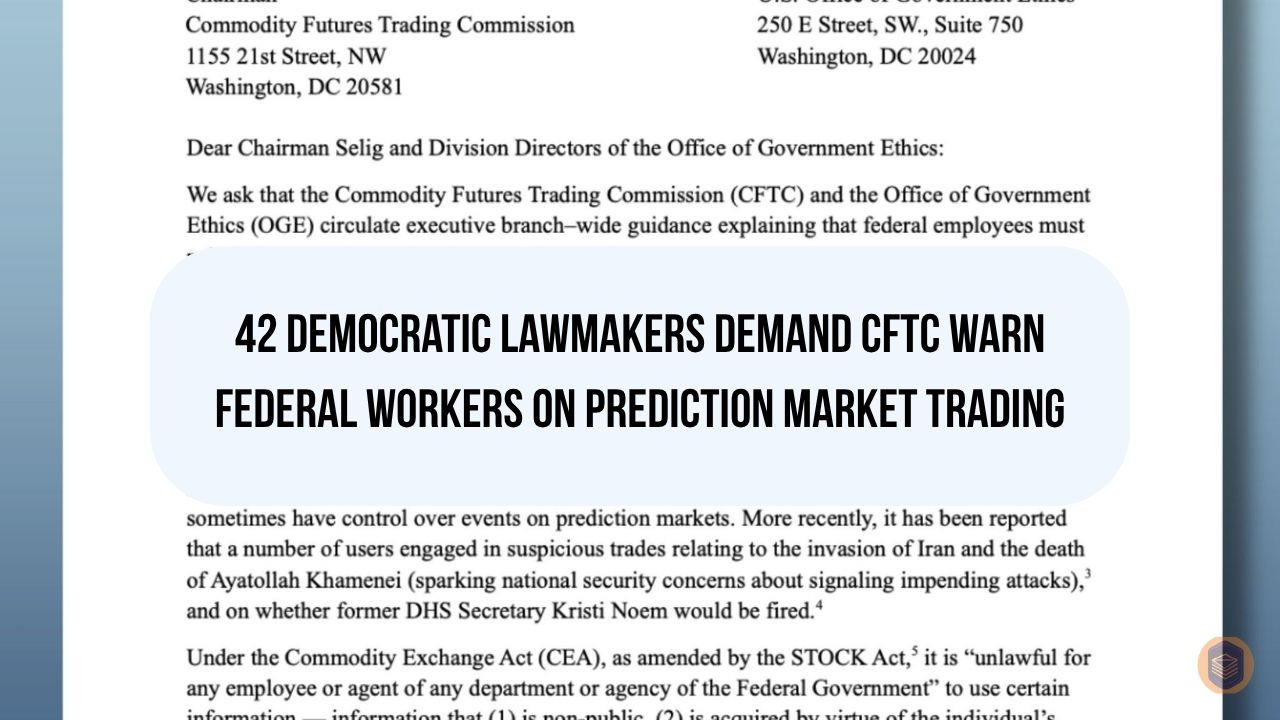
At least 42 Democratic lawmakers have formally requested that the United States Commodity Futures Trading Commission and the Office of Government Ethics issue comprehensive guidance warning federal employees against using insider information to trade on prediction markets.
The letter, addressed to CFTC Chair Mike Selig and the Office of Government Ethics, cited “multiple incidents” that have raised concerns about potential insider trading by government workers on platforms that allow users to bet on future events. The lawmakers are demanding action to prevent federal employees from exploiting non-public information for personal financial gain.
“We ask that the Commodity Futures Trading Commission and the Office of Government Ethics circulate executive branch–wide guidance explaining that federal employees must refrain from insider trading in prediction markets,” the lawmakers wrote in their formal request.
Prediction markets have experienced explosive growth in recent years, allowing users to trade contracts based on outcomes of political events, economic indicators, and other future occurrences. However, this growth has been accompanied by mounting scrutiny over potential insider trading violations and concerns about whether these platforms constitute illegal gambling.
See also: SEC and CFTC to Deepen Crypto Oversight With Joint Meetings and Coordinated Exams
The letter specifically highlighted several suspicious trading incidents that have sparked concerns among lawmakers. Users placed bets on the capture of Venezuelan leader Nicolás Maduro, while others wagered on the exact length of White House press secretary Karoline Leavitt’s speech on Jan. 7.
“More recently, it has been reported that many users engaged in suspicious trades relating to the invasion of Iran and the death of Ayatollah Khamenei, sparking national security concerns about signaling impending attacks, and on whether former DHS Secretary Kristi Noem would be fired,” the lawmakers detailed in their letter.
The two largest prediction market platforms, Kalshi and Polymarket, have already announced plans to implement guardrails aimed at preventing insider trading incidents. These measures come as both platforms face increasing regulatory pressure and public scrutiny over their operations.
The Democratic lawmakers are invoking the Stop Trading on Congressional Knowledge Act, commonly known as the STOCK Act, which former President Barack Obama signed into law in 2012. The legislation was designed to explicitly prohibit government officials from using material, non-public information for personal financial benefit.
In their letter, the lawmakers argued that the CFTC’s own regulatory determinations mean prediction market contracts fall under the STOCK Act’s jurisdiction. “The CFTC has determined that event contracts are derivatives that depend on the occurrence or non-occurrence of an event with a potential financial, economic, or commercial consequence,” they wrote.
The lawmakers concluded that this regulatory classification has clear legal implications: “Thus, the CEA’s prohibition on government officials engaging in insider trading also applies to such activity in prediction markets.”
The group has requested a comprehensive briefing and detailed answers to multiple questions by April 13. Among their inquiries, lawmakers are asking whether the CFTC has investigated or received any reports of federal employees engaging in insider trading on prediction markets.
See also: Polymarket Records $200M in Crypto on the Line for US Presidential Election Outcome
They are also seeking detailed information about what specific steps the CFTC is currently taking to detect and prevent insider trading by federal employees on these platforms. The lawmakers want clarity on enforcement mechanisms and monitoring systems that may be in place or under development.
The letter represents the latest challenge facing the prediction markets industry, which has seen exponential growth in trading volume but faces an uncertain regulatory future. The industry’s expansion has attracted attention from multiple government agencies concerned about market integrity, national security implications, and compliance with existing financial regulations.
As prediction markets continue to gain mainstream adoption and attract billions of dollars in trading volume, the tension between innovation and regulation appears likely to intensify. The lawmakers’ intervention signals that government oversight of these platforms will remain a contentious issue throughout 2025 and beyond.
If you’re reading this, you’re already ahead. Stay there, by joining the…
Discover more from Dipprofit
Subscribe to get the latest posts sent to your email.