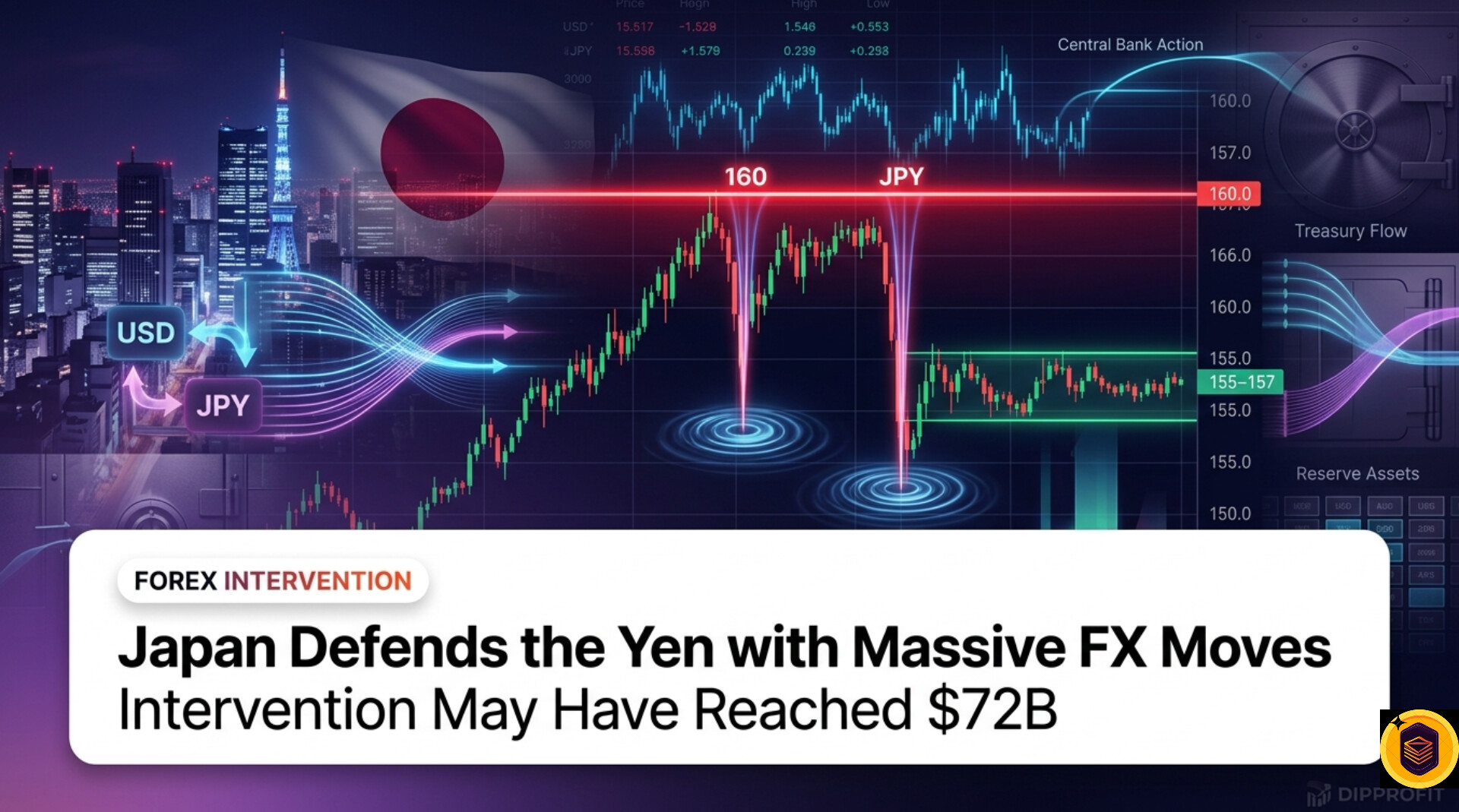

Japan’s Ministry of Finance appears to have executed significant yen-buying operations during the recent Golden Week holiday period, with Bank of America analysts estimating the interventions could total approximately $72 billion. This would mark the largest intervention episode since 2022, according to the bank’s strategists.
Bank of America strategist Shusuke Yamada identified at least four separate occasions when Japanese authorities likely intervened in currency markets. Price action on April 30, May 1, May 4, and May 6 all showed movements consistent with official dollar-selling operations by the Ministry of Finance.
Following the interventions, the USD/JPY pair held consistently in a tight range. Post-intervention lows stabilized in the 155s while highs remained capped in the 157s, with the first operation triggered from the low-160s level.
Yamada noted that the Japanese government appears to view the 160 level on USD/JPY as a critical threshold. Previous intervention episodes in April-May 2024 and July 2024 also began when the currency pair was trading in the high-150s to low-160s range, suggesting this represents an unofficial line in the sand for policymakers.
The scale of the current intervention series is substantial. Bloomberg estimated the April 30 operation alone at 5.4 trillion yen based on Bank of Japan current account data.
Using historical patterns from past interventions, Yamada applied a rough rule of thumb of approximately 1 yen of USD/JPY movement per 1 trillion yen deployed. Based on this calculation, the full series of recent operations could amount to around 11 trillion yen, or roughly $72 billion, though the strategist emphasized this estimate carries high uncertainty.
Japan maintains foreign exchange reserves standing close to $1.4 trillion, meaning funding capacity is not an immediate concern for continued intervention if authorities choose to proceed. Yamada calculated that if intervention operations were to stop and cash balances were maintained through maturing securities and investment income, the implied asset sales into markets would be on the order of $40-50 billion. Market participants generally assume such sales would primarily involve U.S. Treasuries.
The timing and frequency of Japan’s interventions are constrained by international monetary guidelines. Yamada highlighted Japan’s status under the International Monetary Fund’s free-floating currency classification, which permits no more than three intervention episodes of up to three business days each within any six-month window.
Recent operations have stayed within that limit, and price action on May 6 suggested a second distinct episode may have already begun. This framework keeps May 7 and May 8 in play for potential additional intervention action, according to the Bank of America strategist.
The currency interventions come as markets watch the Bank of Japan’s monetary policy trajectory closely. Yamada wrote that momentum toward a Bank of Japan interest rate hike at the June meeting is unlikely to fade. The market is currently pricing in approximately a 70% probability of a June rate move by the Japanese central bank.
If large-scale intervention were to temporarily lift the yen and push June rate hike pricing down to around 40%, it would be viewed as an opportunity for traders to position for higher rates, Yamada said. This suggests that currency intervention and monetary policy expectations remain closely intertwined in the current market environment.
The USD/JPY pair was trading near 156.34 at the time of the report, down slightly by 0.03% in recent trading. The Japanese yen has remained under pressure in recent years as the interest rate differential between Japan and other major economies, particularly the United States, has widened significantly.
Japan’s willingness to deploy substantial resources to support its currency reflects ongoing concerns about inflation imported through a weaker yen and the impact on household purchasing power. The country’s heavy reliance on imported energy and raw materials makes it particularly sensitive to currency depreciation.
More Reads:
Luffa Rebrands as AI × Web3 Super Connector to Bridge Digital Fragmentation
Indian Rupee Surges 0.8% as Oil Prices Plunge on U.S.-Iran Peace Deal Reports
If you’re reading this, you’re already ahead. Stay there, by joining the…
Dipprofit’s private Telegram community

Discover more from Dipprofit
Subscribe to get the latest posts sent to your email.