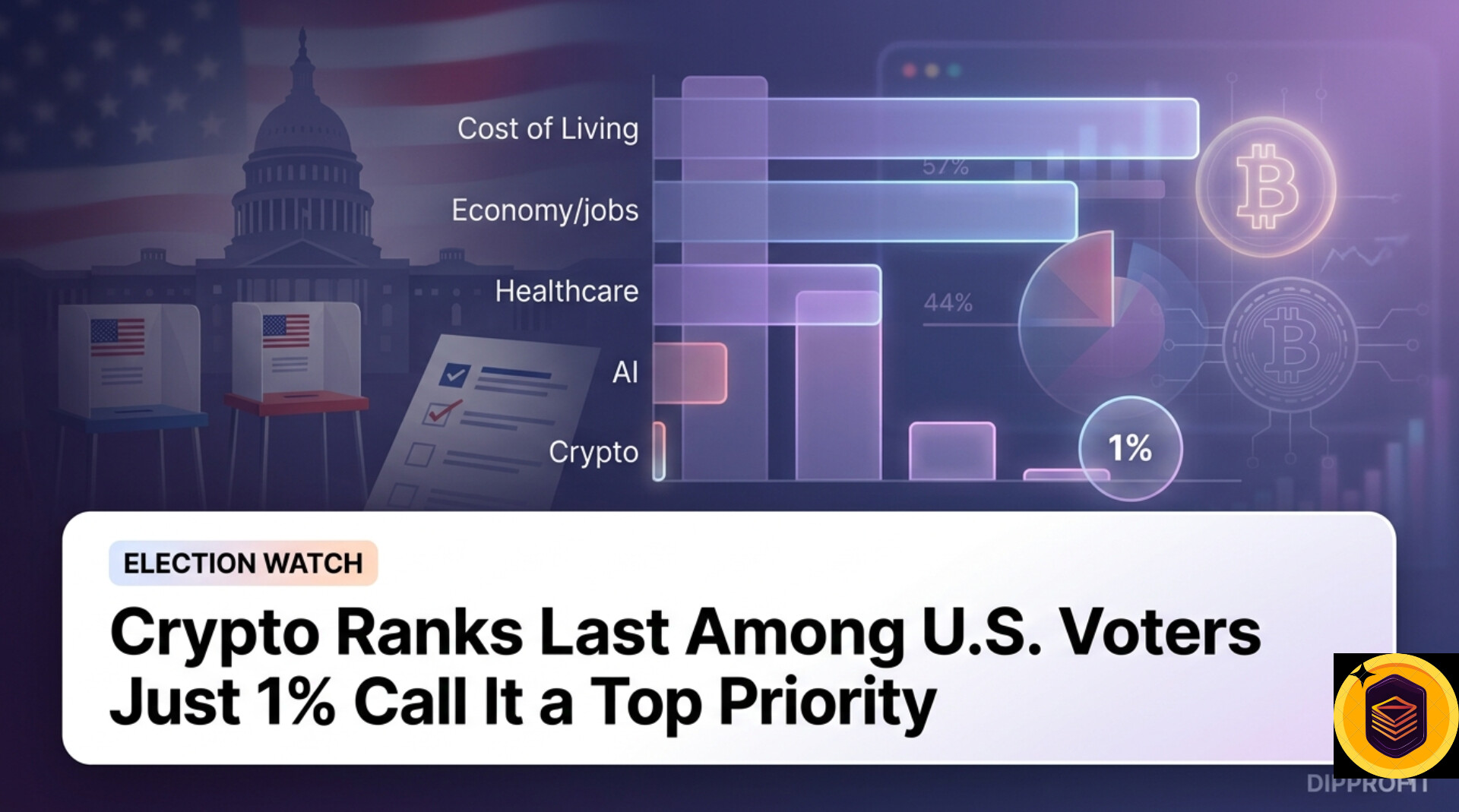

Cryptocurrencies have fallen to the bottom of American voters’ concerns heading into the 2026 midterm election, according to a new CoinDesk survey. Just 1% of 1,000 randomly selected registered voters ranked crypto as their top priority, revealing a significant disconnect between the industry’s political ambitions and voter sentiment on the ground.
The survey, conducted by Public Opinion Strategies near the end of April, paints a sobering picture for an industry that spent hundreds of millions of dollars supporting candidates in 2024. While crypto may not appear on the ballot itself, the stakes remain high for the sector, with key legislation like the Clarity Act still pending and broader tax reform expected to reach Congress in coming months.
Cost of living dominated voter concerns, with 36% of respondents citing it as their single most important issue. Jobs and the economy came in second at 13%, followed by Social Security and Medicare at 11%. Immigration, healthcare, national security and government spending all registered single-digit percentages. Artificial intelligence barely edged out crypto, capturing just 2% of responses as voters’ top concern.
The survey was evenly split between Republican and Democrat respondents, with a credibility interval of plus or minus 3.53%. Results showed President Donald Trump with a net negative approval rating, with 60% of respondents disapproving of his performance compared to 40% who approved.
See also: Bitcoin Risks Extended Decline After Futures-Driven April Rally, CryptoQuant Warns
Americans hold decidedly unfavorable views of cryptocurrencies overall. While GOP-leaning voters showed slightly more favorable than unfavorable sentiment toward crypto at 41% to 39%, every other demographic segment tilted negative. Democrats showed the strongest skepticism, with base Democrats registering 58% unfavorable versus just 25% favorable. Independents and Democrat-leaning voters also expressed clear disapproval, at 48% and 54% unfavorable respectively.
Adoption remains limited among the general population. Just over a quarter of participants, 27%, said they had invested, traded or used cryptocurrency. Another 27% said they haven’t but might consider it in the future. Among those with crypto holdings, the amounts are modest. Only 2% of investors hold more than $10,000 in digital assets, while 9% own between $1,001 and $10,000, and 12% hold $1,000 or less. This follows a pattern seen in related coverage on secure digital wallet setup, suggesting many newcomers are still learning the basics.
Interestingly, voters perceive Republicans as far more supportive of crypto than Democrats. Forty-seven percent of respondents said Republicans were more crypto-friendly, compared to just 14% who said the same about Democrats. Yet this perception doesn’t necessarily translate to greater trust. Democrats maintained a slight edge in voter confidence on crypto policy, with 27% trusting the party compared to 25% for Republicans. Notably, 40% of respondents said they trusted neither party on the issue.
Crypto’s overall favorability rating stands at just 30%, trailing both major political parties. Republicans registered 39% favorability while Democrats hit 43%. Decentralized finance, or DeFi, fared even worse at 17% favorable, though only 60% of respondents had even heard of it. Artificial intelligence performed significantly better, with 46% favorable versus 45% unfavorable, according to data from CoinDesk.
Despite ranking crypto dead last as a top concern, a more nuanced picture emerges when voters are asked directly about crypto’s importance to the 2026 election. Three percent said it was the single most important issue, while an additional 22% called it an important issue. That 25% combined figure represents substantially higher awareness than voters demonstrated several years ago.
See also: How Do I Set Up Secure Digital Wallets for Crypto Assets?
Among voters who expressed heightened interest in the 2026 election compared to 2022, 49% said they owned $1,000 or more in crypto. This suggests that crypto holders may be more engaged in the electoral process, even if the broader electorate remains indifferent.
Roughly 40% of respondents said they would be more likely to vote for a candidate who shared their views on crypto, though the survey did not clarify whether this reflected positive or negative sentiment toward the asset class.
The 2026 midterm landscape appears favorable for Democrats in the House, with generic ballot polling showing a 44% to 41% Democratic advantage. The Senate race remains tighter, with prediction markets showing an even split. Cook Political Report noted in April that Democrats face a much steeper climb to secure a Senate majority.
CoinDesk will release additional data from this survey on Tuesday at Consensus Miami, providing further insight into voter attitudes on digital assets and election priorities.
More Reads:
Bitcoin Doesn’t Need Fresh Narrative to Reclaim $100K, Says Analyst
BNB Weekly Analysis: Week 18 Market Overview
If you’re reading this, you’re already ahead. Stay there, by joining the…
Dipprofit’s private Telegram community

Discover more from Dipprofit
Subscribe to get the latest posts sent to your email.