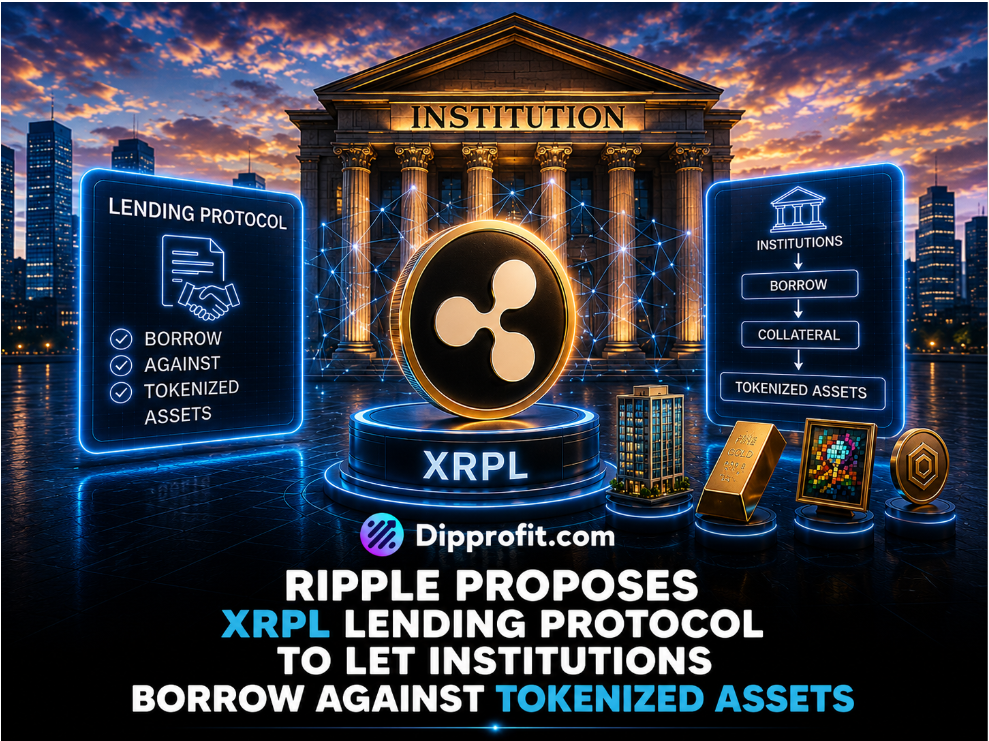

Ripple Proposes XRPL Lending Protocol
Ripple is moving to add a lending layer to the XRP Ledger, proposing a new protocol that would allow institutions to borrow against assets held on-chain rather than simply issuing and transferring them. The XRPL Lending Protocol represents a significant expansion of the blockchain’s utility beyond payments, targeting institutional borrowers who need short-term financing backed by tokenized collateral.

The proposed system splits responsibilities between the blockchain and traditional finance. The XRP Ledger would handle the mechanical enforcement of loan terms, including how money pools together, how interest accrues, how repayment is processed, and how defaults are handled. Credit decisions, however, would remain off-chain with lending institutions that understand borrower creditworthiness and navigate varying jurisdictional requirements.
This hybrid approach reflects Ripple’s belief that blockchains excel at enforcing rules consistently but cannot make sound credit judgments. The protocol consists of two components defined in technical drafts known as XLS-65 and XLS-66. Single Asset Vaults would pool individual assets, while the lending layer would convert those pools into loans with predetermined terms. Both proposals require approval from the validators who operate the network and are currently available only on a development network.
Ripple’s primary use case centers on short-term financing for payment companies. A firm holding reserves in RLUSD, Ripple’s US dollar-pegged stablecoin, might need immediate cash to fund outgoing payments before a cross-border settlement clears in two days. Rather than drawing on traditional bank credit lines or liquidating assets, the company could borrow against the incoming settlement through an approved pool, with repayment automatically enforced by the protocol.
See also: Tether Unlocks $23 Billion Gold Reserve With Bullion-Backed Lending Program
The infrastructure targets institutional users rather than retail participants and operates separately from XRP, the token the network is best known for. This follows a pattern seen in related coverage of asset-backed lending programs where established financial entities leverage blockchain infrastructure for specific use cases.
Ripple enters a competitive landscape where on-chain lending already operates at scale. Protocols including Aave, Compound, Maple, and Clearpool collectively manage billions in deposits. However, Ripple argues that these systems were built around crypto-native governance models where protocols can alter risk rules through community votes, creating unpredictability that institutions cannot underwrite in advance.
Ripple’s counter-argument emphasizes fixed mechanics at the network’s base layer. By hardcoding lending behavior into the XRP Ledger itself, the protocol would prevent rule changes that could shift risk underneath lenders. The system remains public rather than restricted to closed groups, distinguishing it from some permissioned alternatives while maintaining the predictability institutions require.
The distinction matters for institutional adoption. Traditional finance operates on the assumption that rules remain stable and knowable. Crypto-native governance introduces variables that compliance and risk teams struggle to model. By anchoring lending mechanics to the blockchain’s foundation rather than community votes, Ripple attempts to bridge this gap.

See also: Ripple’s CASP MiCA License Application: What We Know About the July 1 Deadline
Data from CoinGecko shows the broader DeFi lending market continues expanding, but institutional participation remains concentrated in platforms offering predictable risk frameworks. Ripple’s approach directly addresses this institutional preference for certainty over flexibility.
The XRPL Lending Protocol proposals are subject to validator approval in the coming weeks. Infrastructure providers and developers can begin integrating and testing on the testnet starting Monday. Validators, who secure and operate the XRP Ledger, will ultimately determine whether these features proceed to mainnet deployment.
Success would represent a meaningful expansion of Ripple’s institutional strategy. The company has long positioned itself as the blockchain solution for traditional finance, emphasizing regulatory compliance and institutional-grade infrastructure. Adding lending capabilities would deepen that positioning, offering a complete financial services stack on a single blockchain.
The timing aligns with broader institutional interest in blockchain-based financial infrastructure. Banks and payment processors increasingly explore on-chain settlement and asset tokenization, creating natural demand for financing mechanisms that operate natively on blockchain networks.
If you’re reading this, you’re already ahead. Stay there, by joining the…
Dipprofit’s private Telegram community
Discover more from Dipprofit
Subscribe to get the latest posts sent to your email.