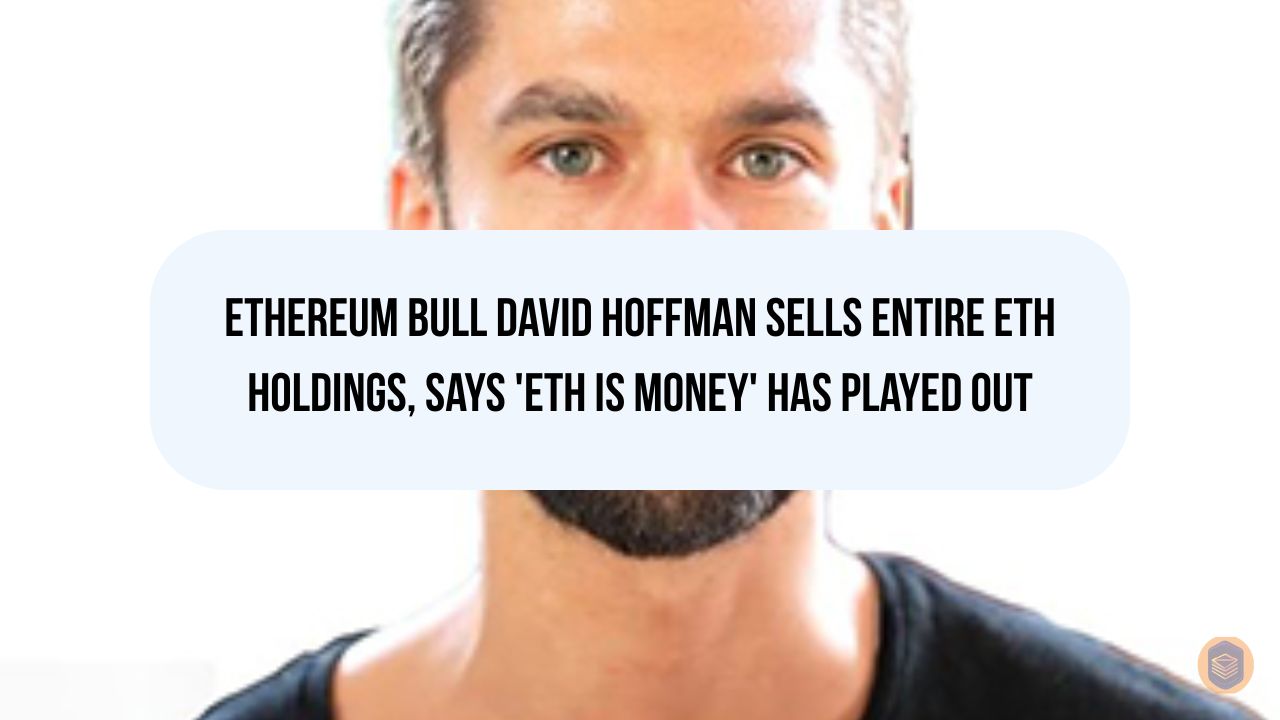

David Hoffman, co-founder of the media company Bankless and a long-time Ethereum advocate, has sold his remaining Ether (ETH) holdings, marking a significant shift in perspective for one of the blockchain’s most vocal supporters. In an X post on Tuesday, Hoffman explained that while Ethereum has performed well, the window for ETH to be revalued by the market appears to be closing, and the popular ‘ETH is Money’ investment thesis has largely run its course.
Hoffman stated that ‘Ethereum got the ETH price it deserves, and I don’t see ETH being rerated as an asset, higher or lower.’ The Bankless co-founder acknowledged that Ethereum ‘has done incredibly well, and deserves the market cap that it has,’ but emphasized that the opportunity for significant price appreciation seems limited. He did not disclose the value of his ETH holdings at the time of the sale on May 21.

The ‘ETH is Money’ thesis, which has been central to Ethereum’s investment narrative for years, posits that the token functions as a superior store of value compared to traditional fiat currencies due to its decentralized nature and built-in mechanisms designed to combat inflation through controlled token issuance. Many Ether backers have long believed the token could reach five-figure valuations based on this thesis.
However, ETH’s price performance has disappointed those holding this view. The token reached an all-time high of just below $5,000 in August, matching its previous bull market peak from the last cycle. Since then, ETH has declined by approximately 60 percent from its peak to trade around $2,000. This follows a pattern seen in Bitcoin and Ethereum ETFs shedding $112M while Hyperliquid funds extend winning streak, reflecting broader market pressures on major digital assets.
See also: Bitcoin and Ethereum ETFs Shed $112M While Hyperliquid Funds Extend Winning Streak
Hoffman’s reasoning extends beyond price considerations. He characterized Ethereum as a ‘giver, not a taker,’ explaining that the network provides secure blockspace and tokenization capabilities at cost while layer-2 networks capture most of the fees and benefits. ‘Ethereum takes no markup for anything it does. This is the nature of open source software, and this is the power of Ethereum,’ Hoffman noted, highlighting the protocol’s commitment to providing value without extracting economic rent.
Despite selling his entire position, Hoffman maintained that he remains ‘massively bullish’ on Ethereum’s future development and expects the network to perform ‘exceptionally well from here on out.’ His caveat, however, is crucial: only a ‘marginal amount’ of that success will be reflected in the ETH token’s price. This distinction between network success and token appreciation represents a fundamental shift in how Hoffman views the investment case for Ether.
Hoffman’s decision generated mixed reactions within the Ethereum community. Ryan Sean Adams, his co-founder at Bankless, characterized the move as the ‘end of an era,’ signaling the symbolic weight of Hoffman’s departure from holding ETH. Former Ethereum core developer Eric Connor offered a more sympathetic perspective, noting that he didn’t blame Hoffman given that ETH has ‘grossly underperformed the general crypto market for many years now.’

See also: Ethereum Weekly Analysis: Week 18 Market Overview
Connor attributed the underperformance primarily to selling pressure from the large cohort of millionaires created during Ethereum’s explosive early growth phase, rather than to fundamental protocol weaknesses. ‘At the end of the day, maximalism to a single coin when it comes to portfolio management is pretty silly,’ Connor stated, suggesting that diversification may be a more prudent approach than concentrated holdings in any single asset.
The timing of Hoffman’s exit coincides with other challenges facing Ethereum, including concerns about total value locked hitting 13-month lows, according to CoinGecko data. These metrics suggest that despite the network’s technical capabilities and growing adoption, the token itself may face structural headwinds that limit its appreciation potential relative to other crypto assets.
Hoffman’s decision underscores a growing recognition among sophisticated Ethereum observers that network success and token value appreciation may not be perfectly correlated. As the blockchain industry matures, this distinction between protocol utility and token economics will likely become increasingly important for investors evaluating long-term positions in major digital assets.
If you’re reading this, you’re already ahead. Stay there, by joining the…
Discover more from Dipprofit
Subscribe to get the latest posts sent to your email.