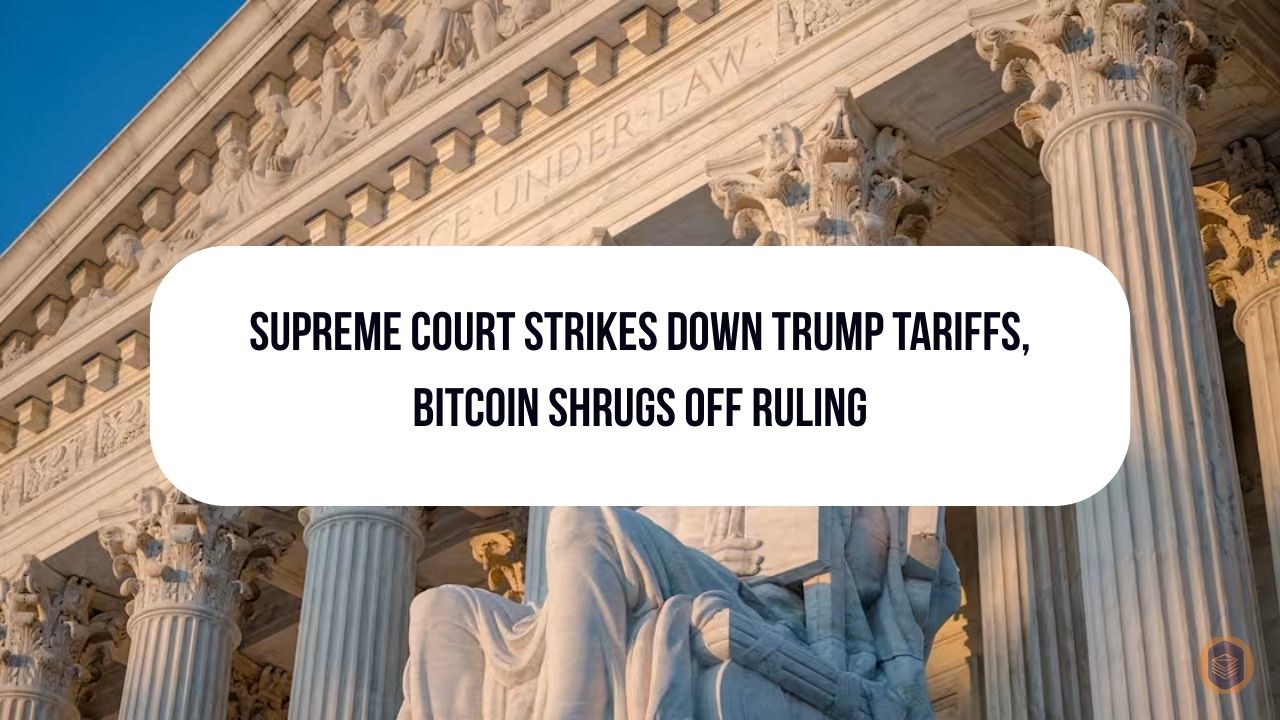
The Supreme Court ruled 6-3 on Friday that President Trump’s sweeping tariffs exceeded his authority under the International Emergency Economic Powers Act.
The decision, which crypto markets had largely priced in, prompted Bitcoin to tick up briefly to $67,800 before settling back near $67,000. What caught traders off guard wasn’t the ruling itself (prediction markets had put the probability at 74%) but Trump’s same-day announcement of a replacement 15% global tariff under a different legal authority.
Chief Justice Roberts wrote in the majority opinion that the administration’s reading of IEEPA would represent a “transformative expansion of the President’s authority over tariff policy” with no precedent in U.S. history.
Trump quickly dismissed the ruling as “anti-American” on Truth Social and pivoted to Section 122 of the Trade Act of 1974 as his new legal basis for tariffs.
Bitcoin’s initial 1-2% rally evaporated in 90 minutes, revealing that the market had already digested the likely outcome. The real story emerged over the weekend when a bigger sell-off hit crypto markets.
Bitcoin plunged as low as $64,000 (down nearly 5%) while Ethereum fell below $1,900 and Solana dropped below $80. Over $400 million in long positions were liquidated as Bitcoin crashed.
For the crypto market, the tariff ruling has created two potential paths forward. The first is a relief rally scenario: lower tariff revenue expectations could reduce inflation, bringing Federal Reserve rate cuts back onto the table. This would create a risk-on environment favorable to speculative assets like Bitcoin.
The second narrative is longer-term and arguably more bullish for crypto’s core thesis. If tariff revenues disappear and the federal deficit widens, the dollar could weaken, and money printing could accelerate. That scenario directly supports Bitcoin’s narrative as a hedge against monetary debasement.
Both outcomes theoretically favor crypto. But there’s a political wildcard. Any voter pushback against the tariff debacle (now ruled illegal by the Supreme Court) could shift seats toward Democrats. That would create headwinds for pro-crypto legislation like the Clarity Act, which remains months away from consideration.
Broader economic data is adding pressure to markets. Q4 2025 GDP badly missed expectations, coming in at 1.4% annualized versus the 3% consensus. A 43-day government shutdown subtracted roughly 1 percentage point from growth, while exports reversed and consumer spending decelerated.
Meanwhile, PCE inflation ticked up to 2.9%, creating the worst possible scenario: slow growth alongside sticky prices. Bitwise warned of further Bitcoin weakness, citing continued macro pressure and the need for equity market stability before any sustained crypto rally can materialize.
Bitcoin ETFs saw nearly $300 million in net outflows last week, while Ethereum ETFs experienced $113 million in outflows. Tether’s circulating USDT supply has fallen by $1.5 billion so far in February and is down nearly $4 billion from its local peak, suggesting some rotation away from stablecoin holdings.
The crypto market should have clarity on whether a relief rally is coming by mid-March. If one doesn’t materialize, traders are bracing for a crypto winter lasting another six or more months. The immediate question is whether markets will view the tariff ruling as inflationary (money printing ahead) or deflationary (growth slowdown ahead).
An answer likely depends on whether Trump’s replacement tariff under Section 122 survives legal challenges. That’s a fight that could stretch into the coming weeks, keeping tariff uncertainty alive even after the Supreme Court’s ruling.
In other news, Ethereum confirmed FOCIL (EIP-7805) as the headline feature of its Hegota upgrade, slated for the second half of 2026. The mechanism will force validators to include all valid transactions, making censorship a protocol-level impossibility.
BGD Labs, the team behind Aave’s smart contracts, announced it is leaving Aave DAO after four years. Separately, World Liberty Financial announced plans to tokenize loan revenue interests in the Trump International Hotel & Resort in the Maldives via Securitize, drawing scrutiny from 41 House Democrats over potential banking charter approval.
If you’re reading this, you’re already ahead. Stay there, by joining the…
Dipprofit’s private Telegram community
Discover more from Dipprofit
Subscribe to get the latest posts sent to your email.