When people first hear about Forex trading, many imagine millions of individual traders sitting behind computer screens buying and selling currencies throughout the day.
While retail traders certainly participate in the market, they represent only a small fraction of the global foreign exchange ecosystem.
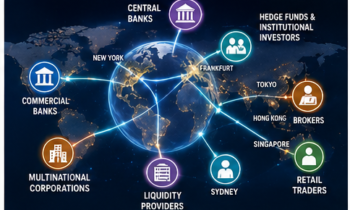
The Forex market is a vast financial network where commercial banks, central banks, multinational corporations, hedge funds, investment firms, governments, brokers, liquidity providers, and retail traders interact continuously. Together, these participants facilitate international trade, investment, tourism, business operations, and speculative trading.
With an average daily trading volume measured in trillions of U.S. dollars, Forex remains the world*s largest and most liquid financial market. Unlike stock exchanges such as the New York Stock Exchange (NYSE) or the London Stock Exchange (LSE), Forex has no single physical location. Instead, it operates through an interconnected electronic network that links financial institutions across the globe.
Understanding who participates in this market and how these participants interact is one of the most important steps toward becoming a knowledgeable Forex trader.
Understanding the Forex Market Structure
Before learning who trades Forex, it is essential to understand how the market itself is organized.
Unlike stock markets, the Forex market is decentralized. There is no central exchange where every buyer and seller meets to execute trades.
Instead, trading takes place electronically through a worldwide network of banks, financial institutions, brokers, and liquidity providers.
This system is commonly referred to as the Over-the-Counter (OTC) market.
Rather than routing every trade through a single exchange, market participants negotiate prices electronically across interconnected banking networks.
This decentralized structure allows the Forex market to remain open twenty-four hours a day from Monday to Friday.
Why Does Forex Not Have a Central Exchange?
Imagine if every international business had to travel to one physical building just to exchange currencies.
Global commerce would become painfully slow.
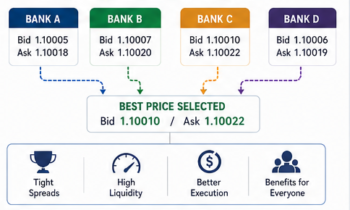
Instead, banks around the world continuously quote exchange rates electronically.
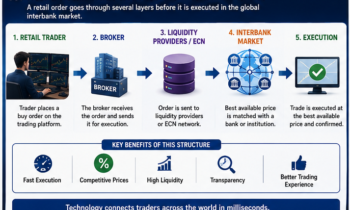
Whenever someone buys or sells a currency pair, their order moves through electronic networks until it finds another participant willing to take the opposite side of the trade.
This decentralized model offers several advantages.
Continuous Trading
Because different financial centers operate in different time zones, the Forex market remains active almost continuously throughout the business week.
High Liquidity
Thousands of institutions constantly provide buying and selling prices.
This creates deep liquidity, allowing traders to enter and exit positions efficiently under normal market conditions.
Competitive Pricing
Perhaps the greatest advantage is competition.
Banks compete aggressively to offer attractive exchange rates.
Since multiple institutions continuously quote prices, spreads often remain extremely tight, particularly for major currency pairs such as EUR/USD, GBP/USD, and USD/JPY.
Competition among banks ultimately benefits everyone in the market, including retail traders.
The Forex Market Hierarchy
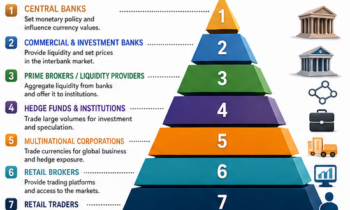
Although Forex appears to function as one large marketplace, it actually resembles a pyramid.
Participants closer to the top generally enjoy better pricing, greater liquidity, and direct market access.
Those lower in the hierarchy access the market through intermediaries.
The hierarchy can be visualized as follows:
Central Banks
Large Commercial and Investment Banks
Prime Brokers
Hedge Funds and Institutional Investors
Multinational Corporations
Retail Brokers
Individual Retail Traders
Each level plays a different role within the ecosystem.
Who Trades Forex? Meet the Five Major Market Participants
Although dozens of organizations participate in currency markets, they generally fall into five primary categories.
Understanding each participant helps explain why currencies move throughout the day.
1. Commercial Banks (The Largest Players)
Commercial and investment banks form the backbone of the Forex market.
These institutions facilitate currency exchange for businesses, governments, institutional investors, and high-net-worth clients.
Examples include internationally recognized banking groups operating across multiple financial centers.
Large banks continuously buy and sell currencies on behalf of clients while simultaneously trading for their own portfolios.
Because of their enormous transaction volumes, banks often receive the best available prices.
Their activity largely determines the exchange rates quoted across the global market.
When banks compete with one another to provide liquidity, spreads narrow, making currency trading more efficient for everyone.
This is one reason major currency pairs frequently exhibit extremely tight spreads during active trading sessions.
2. Central Banks
Unlike commercial banks, central banks are not attempting to earn short-term trading profits.
Their primary responsibility is maintaining economic stability.
Central banks influence currency values through:
Interest rate decisions
Monetary policy
Inflation control
Currency interventions
Foreign reserve management
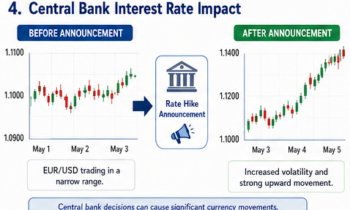
Whenever a central bank raises or lowers interest rates, currency markets often respond immediately.
For example, if investors expect higher interest rates, demand for that country*s currency may increase because higher yields become more attractive.
Occasionally, central banks also intervene directly by buying or selling their own currency to stabilize excessive price movements.
These actions can significantly affect exchange rates.
Retail traders carefully monitor central bank announcements because they frequently generate some of the largest market moves of the year.
3. Multinational Corporations
Many companies participate in Forex markets even though they have no intention of becoming currency traders.
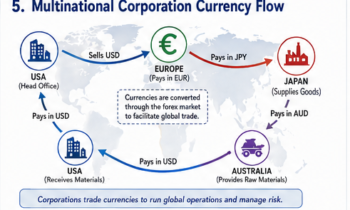
Imagine a European automobile manufacturer purchasing steel from Japan.
The company must convert euros into Japanese yen before completing payment.
Similarly, an American technology company paying employees in Europe needs euros rather than U.S. dollars.
These routine business activities generate billions of dollars in daily currency transactions.
Large multinational corporations also hedge foreign exchange risk.
Suppose a company expects to receive £500 million from customers six months from now.
If the British pound weakens before payment arrives, the company*s revenue declines after conversion into its domestic currency.
To reduce this risk, corporations often lock in exchange rates using forward contracts and other hedging instruments.
Their objective is not speculation.
It is stability.
4. Investment Managers, Hedge Funds, and Institutional Investors
Some of the world*s largest investment firms actively trade currencies.
These institutions manage enormous portfolios on behalf of pension funds, sovereign wealth funds, insurance companies, university endowments, and private clients.
Unlike corporations, many institutional investors trade currencies for speculative profit.
Their decisions often combine:
Fundamental analysis
Technical analysis
Macroeconomic forecasts
Interest rate expectations
Inflation trends
Political developments
Market sentiment
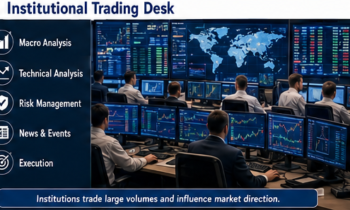
Because institutional orders can involve hundreds of millions of dollars, they frequently influence short-term market direction.
Retail traders often attempt to identify institutional buying and selling activity by studying price action and market structure.
5. Retail Forex Traders
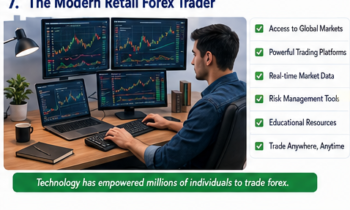
Retail traders are the newest and fastest-growing group in the Forex market. They are individual investors who speculate on currency price movements using online trading platforms provided by Forex brokers.
Unlike banks or multinational corporations, retail traders typically trade with their own capital. Their primary goal is to profit from fluctuations in exchange rates rather than facilitate international business transactions.
Decades ago, participating in the Forex market was virtually impossible for the average person. Currency trading was reserved for large financial institutions with access to the interbank market. Today, advances in technology have transformed the landscape. Anyone with a computer or smartphone, an internet connection, and a regulated Forex broker can access the same market that banks and hedge funds trade every day.
Retail traders employ a wide variety of strategies depending on their experience, available time, and risk tolerance. Some focus on short-term price movements as scalpers or day traders, while others hold positions for several days or weeks as swing traders. Long-term position traders may keep trades open for months, relying heavily on macroeconomic trends and monetary policy.
Although retail traders account for only a small percentage of the total Forex market by trading volume, they represent millions of participants worldwide and contribute significantly to overall market liquidity.
The Supporting Players Behind the Forex Market
The five groups above make up the core Forex market participants, but several other entities play vital supporting roles behind the scenes.
Forex Brokers
Retail traders cannot access the interbank market directly. Instead, they place trades through Forex brokers.
A broker acts as the bridge between individual traders and the broader financial market.
Modern brokers provide:
Trading platforms
Price quotes
Order execution
Market analysis
Educational resources
Risk management tools
Customer support
Some brokers operate as Market Makers, while others use ECN (Electronic Communication Network) or STP (Straight Through Processing) execution models.
Liquidity Providers
Liquidity providers are usually major banks and financial institutions that continuously offer buy and sell prices for currency pairs.
Without liquidity providers, executing trades quickly at competitive prices would be much more difficult.
High liquidity generally leads to:
Faster execution
Lower spreads
Reduced slippage
Better pricing
Electronic Communication Networks (ECNs)
An ECN connects buyers and sellers electronically without requiring a traditional dealing desk.
Instead of relying on a single institution to provide prices, ECNs aggregate quotes from multiple liquidity providers and display the best available bid and ask prices.
Many professional traders prefer ECN accounts because they offer greater pricing transparency and access to institutional-grade liquidity.
Know Your Retail Forex History
Understanding how retail Forex trading evolved provides valuable perspective on today\\\'s market.
The sophisticated trading platforms available today are the result of decades of technological innovation, financial deregulation, and improvements in internet connectivity.
The Early Years: Before Retail Forex
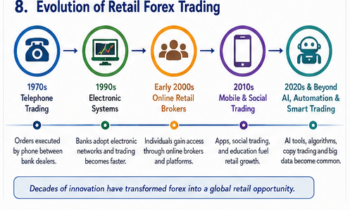
Prior to the 1970s, exchange rates were largely fixed under the Bretton Woods monetary system.
Currencies were tied to the U.S. dollar, while the U.S. dollar itself was backed by gold.
Because exchange rates remained relatively stable, speculative currency trading was limited.
This changed dramatically after the collapse of the Bretton Woods system in the early 1970s.
Countries gradually adopted floating exchange rates, allowing currency values to fluctuate according to supply and demand.
This marked the birth of the modern Forex market.
The Birth of Electronic Forex Trading
During the 1980s and early 1990s, currency trading remained dominated by banks.
Orders were often executed over the telephone between dealing desks.
Trading was expensive, slow, and inaccessible to individuals.
As electronic communication networks emerged, banks gradually shifted toward computerized trading systems.
The internet revolution of the late 1990s accelerated this transformation.
Trading became faster, more transparent, and significantly more efficient.
The Rise of Retail Forex Trading
The early 2000s marked a turning point.
Online brokers began offering individual traders access to leveraged currency trading through user-friendly trading platforms.
Suddenly, people no longer needed millions of dollars to participate.
Small accounts could now access global currency markets.
This democratization of Forex trading fueled explosive industry growth.
Educational websites, online forums, trading communities, and later YouTube accelerated learning opportunities for aspiring traders.
The Evolution of Modern Forex Trading
The Forex market today is vastly different a early
Todays Forex market is vastly different from what existed twenty years ago.
Retail traders now benefit from technologies once reserved exclusively for institutional investors.
Modern trading includes:
Mobile trading applications
Cloud-based trading platforms
AI-assisted market analysis
Advanced charting software
Economic calendar integration
Copy trading
Social trading communities
Automated Expert Advisors (EAs)
Algorithmic trading
VPS hosting for automated strategies
Professional traders increasingly combine traditional technical analysis with data analytics, macroeconomic research, and systematic risk management rather than relying on a single indicator.
Common Beginner Misconceptions About Who Trades Forex
Many new traders enter the market with assumptions that simply are not true.
Let us clear up some of the most common misconceptions.
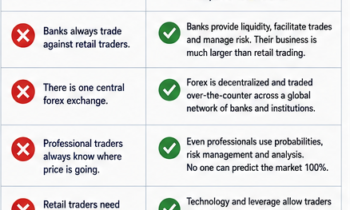
Retail traders move the market.
In reality, individual traders have very little influence on overall currency prices. Major price movements are typically driven by institutional participants, central banks, macroeconomic data, and large-scale order flow.
Banks always trade against retail traders.
Commercial banks primarily facilitate transactions and manage risk. Their business extends far beyond retail speculation.
The Forex market is controlled by one organization.
Forex is decentralized. No single institution controls global exchange rates.
Professional traders always know where price is going.
Even institutional traders manage uncertainty through probabilities, disciplined risk management, and diversified strategies rather than attempting to predict every market movement with certainty.
Recap
Understanding who trades Forex is fundamental to understanding how the market behaves.
The Forex market is not driven solely by retail traders. Instead, it is a global ecosystem where commercial banks, central banks, multinational corporations, institutional investors, brokers, liquidity providers, and millions of individual traders interact continuously.
Its decentralized structure encourages competition among banks, resulting in competitive pricing, tight spreads, and exceptional liquidity. This unique structure allows traders around the world to access one of the most efficient financial markets ever created.
Retail Forex trading has evolved dramatically over the past few decades. What was once an exclusive institutional marketplace is now accessible to anyone with an internet connection and a well-structured trading plan. However, access alone does not guarantee success. Long-term profitability comes from understanding market structure, recognizing the role of each market participant, practicing sound risk management, and continuously improving your knowledge.
Whether you aspire to become a day trader, swing trader, or long-term investor, appreciating the mechanics of the Forex ecosystem provides a stronger foundation for every trading decision you make.
Frequently Asked Questions (FAQs)
Who are the biggest participants in the Forex market?
Commercial and investment banks are the largest participants by trading volume, followed by central banks, institutional investors, multinational corporations, and retail traders.
Why is the Forex market decentralized?
Because currencies are traded electronically through a global network of financial institutions rather than on a single centralized exchange.
Do retail traders trade directly with banks?
Generally, no. Retail traders access the market through regulated Forex brokers, which connect them to liquidity providers or the interbank market.
Why do banks offer different exchange rates?
Banks compete with one another to attract trading volume. This competition contributes to tighter bid-ask spreads and more efficient pricing, especially for major currency pairs.
Can beginners compete with professional traders?
While retail traders cannot match institutional resources, they can become consistently profitable by focusing on education, disciplined risk management, well-tested trading strategies, and emotional control.
Dipprofit Trading AcademySchool of Forex
● Free & Premium Curriculum
Global market knowledge, trade with zero guesswork.
Dipprofit Trading Academy takes you from "what is a pip" to full price-action trading, with graded quizzes, a live leaderboard, and a certificate at the finish line.
Your Overall Progress
—
Sign in to start tracking your progress, rank on the leaderboard, and get a certificate of completion.
📊
Real Progress TrackingEvery quiz score builds your standing
🏆
Global & Level LeaderboardsSee exactly where you rank
🎓
Certificate on CompletionFinish every level, earn your proof
Curriculum
Your path through the School of Forex
"View Lessons" previews a level right here. "Start Lesson" takes you straight into it.