When Can You Trade Forex? (Forex Trading Sessions)
When Can You Trade Forex?
One of the first questions every new trader asks is, When should I trade forex? It is a simple question, but the answer can significantly influence your trading results.
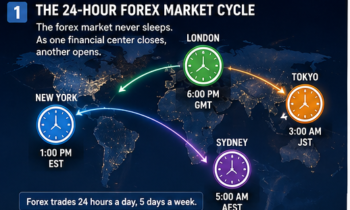
Unlike stock markets that open and close at fixed hours, the Forex market operates 24 hours a day, five days a week, thanks to the continuous opening and closing of financial centers around the world. However, just because the market is always open does not mean every hour offers the same opportunities.
Some trading sessions are quiet with low price movement, while others experience explosive volatility, tighter spreads, and higher liquidity. Understanding these Forex trading sessions allows traders to choose the best time to enter and exit trades based on their strategy, preferred currency pairs, and risk tolerance.
This guide explains everything you need to know about Forex trading sessions, including how they work, when each session opens and closes, which currency pairs perform best during each session, and how professional traders take advantage of session overlaps.
What Are Forex Trading Sessions?
The Forex market follows the global business day. As one major financial center closes, another opens, creating a continuous trading cycle from Monday morning in the Asia-Pacific region until Friday evening in North America.
The four primary Forex trading sessions are:
Sydney Session
Tokyo Session
London Session
New York Session
Each session reflects the trading activity of its respective financial center and has unique characteristics in terms of volatility, liquidity, and trading opportunities.
Understanding the Four Major Forex Trading Sessions
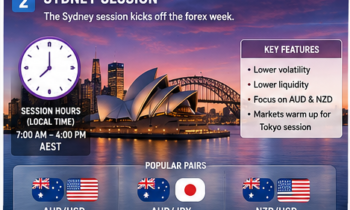
1. Sydney Session
The Sydney session officially begins the Forex trading week.
Characteristics
Lower volatility
Lower liquidity compared to London and New York
Suitable for traders focusing on Australian and New Zealand currencies
Markets gradually gain momentum as Tokyo prepares to open
Popular pairs:
AUD/USD
NZD/USD
AUD/JPY
Many traders use this session to observe how markets react to weekend news before larger trading centers become active.
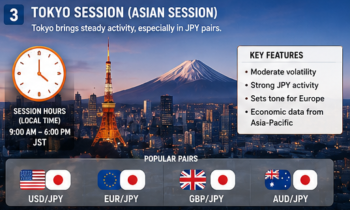
2. Tokyo Session (Asian Session)
Once Tokyo opens, trading activity increases significantly across Asia.
Japan remains one of the world\\\\\\\'s largest financial markets, making this session especially important for Yen-related currency pairs.
Characteristics
Moderate volatility
Strong activity in JPY pairs
Lower spreads compared to Sydney
Often sets the tone for the European trading day
Popular currency pairs include:
USD/JPY
EUR/JPY
GBP/JPY
AUD/JPY
During this session, traders also monitor economic releases from Japan, China, Australia, and New Zealand.
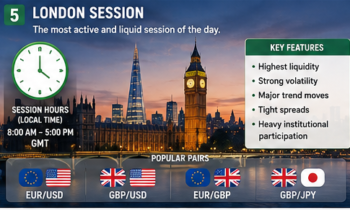
3. London Session
The London session is widely regarded as the most important Forex trading session.
London handles a significant share of global currency transactions, attracting banks, hedge funds, institutions, and retail traders worldwide.
Characteristics
Highest liquidity
Strong volatility
Large institutional participation
Tight spreads
Frequent trend development
Popular pairs:
EUR/USD
GBP/USD
EUR/GBP
GBP/JPY
Professional traders often prefer this session because price movements tend to be cleaner and more sustained than during quieter market hours.
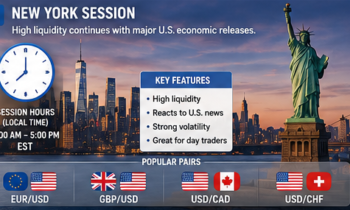
4. New York Session
The New York session becomes particularly active after London has already opened.
Since the United States plays a central role in global finance, economic announcements released during this session often create substantial market volatility.
Characteristics
High liquidity
Strong market reactions to U.S. economic data
Excellent opportunities for day traders
Increased institutional activity
Popular pairs include:
EUR/USD
GBP/USD
USD/CAD
USD/CHF
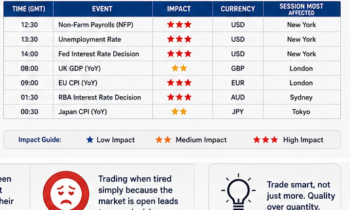
Major U.S. reports such as Non-Farm Payrolls (NFP), CPI, GDP, and Federal Reserve announcements frequently move the market during this session.
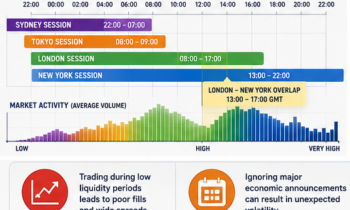
Why the London–New York Overlap Is So Important
Professional Forex traders pay particular attention to the period when the London and New York sessions are open simultaneously.
This overlap typically offers:
The highest liquidity of the trading day
The lowest spreads on major currency pairs
Strong price momentum
Increased trading volume
More reliable technical breakouts
Many institutional traders execute large orders during this period because there are enough buyers and sellers to absorb significant trading volume.
For traders using breakout, momentum, or trend-following strategies, this overlap often presents the most attractive opportunities.
Choosing the Right Session for Your Trading Style
Not every trader benefits from the same trading session.
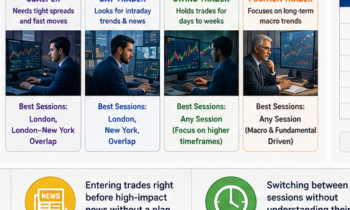
Scalpers
Scalpers seek frequent price movements and tight spreads. They often prefer the London session or the London–New York overlap because of the high liquidity and fast execution.
Day Traders
Day traders usually focus on the London and New York sessions, where intraday trends and economic news provide multiple trading opportunities.
Swing Traders
Swing traders hold positions for several days and may enter trades during any session, but they often wait for higher liquidity periods to reduce execution costs.
Position Traders
Long-term traders are less concerned about session timing. Instead, they focus on macroeconomic trends, interest rate expectations, and broader market sentiment.
Factors That Influence the Best Time to Trade Forex
Although trading sessions are important, they are not the only consideration.
Professional traders also evaluate:
Economic calendars
Central bank meetings
Inflation reports
Employment data
Interest rate decisions
Geopolitical events
Public holidays in major financial centers
For example, even during the London session, trading activity may slow if the United Kingdom observes a bank holiday.
Likewise, unexpected geopolitical developments can trigger significant volatility regardless of the time of day.
Common Mistakes Traders Make When Choosing Trading Hours
Many beginners assume that because the Forex market is open 24 hours a day, every hour offers equal opportunities.
This misconception often leads to poor trade quality.
Avoid these common mistakes:
Trading during extremely low liquidity periods.
Ignoring major economic announcements.
Entering trades immediately before high-impact news without a plan.
Switching between sessions without understanding their characteristics.
Trading when tired simply because the market is open.
Professional traders understand that selective trading is often more profitable than constant trading.
Best Currency Pairs for Each Session
Trading Session
Popular Currency Pairs
Sydney
AUD/USD, NZD/USD, AUD/JPY
Tokyo
USD/JPY, EUR/JPY, GBP/JPY
London
EUR/USD, GBP/USD, EUR/GBP
New York
EUR/USD, USD/CAD, GBP/USD, USD/CHF
Trading pairs closely associated with the active financial center often results in better liquidity and more consistent price action.
Recap
Understanding Forex trading sessions is one of the simplest yet most powerful ways to improve your trading decisions. Rather than treating every hour as an opportunity, successful traders align their strategies with periods of higher liquidity, stronger price movement, and greater market participation.
The Sydney session offers a calm start to the trading week, the Tokyo session brings steady activity to Yen pairs, the London session delivers the highest liquidity and institutional involvement, and the New York session often reacts sharply to major U.S. economic data. For many traders, the overlap between the London and New York sessions provides the best combination of volume, volatility, and trading opportunities.
Ultimately, the best time to trade depends on your strategy, preferred currency pairs, time zone, and lifestyle. Whether you are a scalper seeking rapid intraday movements or a swing trader focusing on longer-term trends, understanding how each session behaves can help you make more informed decisions and avoid trading during less favorable market conditions.
Trading success is not about being active all day. It is about being active when the market offers your strategy the highest probability of success.
Dipprofit Trading AcademySchool of Forex
● Free & Premium Curriculum
Global market knowledge, trade with zero guesswork.
Dipprofit Trading Academy takes you from "what is a pip" to full price-action trading, with graded quizzes, a live leaderboard, and a certificate at the finish line.
Your Overall Progress
—
Sign in to start tracking your progress, rank on the leaderboard, and get a certificate of completion.
📊
Real Progress TrackingEvery quiz score builds your standing
🏆
Global & Level LeaderboardsSee exactly where you rank
🎓
Certificate on CompletionFinish every level, earn your proof
Curriculum
Your path through the School of Forex
"View Lessons" previews a level right here. "Start Lesson" takes you straight into it.