One of the biggest misconceptions among beginner traders is believing that every forex broker earns money in exactly the same way.
That couldn\'t be further from the truth.
In reality, brokers use several different business models to execute trades, manage risk, and generate revenue. Some brokers simply act as intermediaries between you and the market, while others may temporarily become your direct counterparty. Neither approach is automatically good or bad. What matters is understanding how each model works so you know exactly who is on the other side of your trade and what incentives exist.
Once you understand these execution models, you\'ll be able to evaluate brokers far beyond their marketing slogans and determine whether they truly fit your trading style.
How Forex Brokers Make Money
Every legitimate business must generate revenue to remain operational, and forex brokers are no exception.
Running a brokerage involves significant costs. Brokers must maintain secure trading servers, connect to liquidity providers, purchase market data, comply with regulatory requirements, employ customer support teams, and invest in cybersecurity and infrastructure.
To cover these costs and earn a profit, brokers use several revenue sources.
The most common are:
Spreads
Commissions
Financing charges (swap or rollover fees)
Currency conversion fees
Inactivity or administrative fees (only some brokers)
Profits or losses from internalized order flow, depending on their execution model
Let\'s examine each one in detail.
1. Spreads
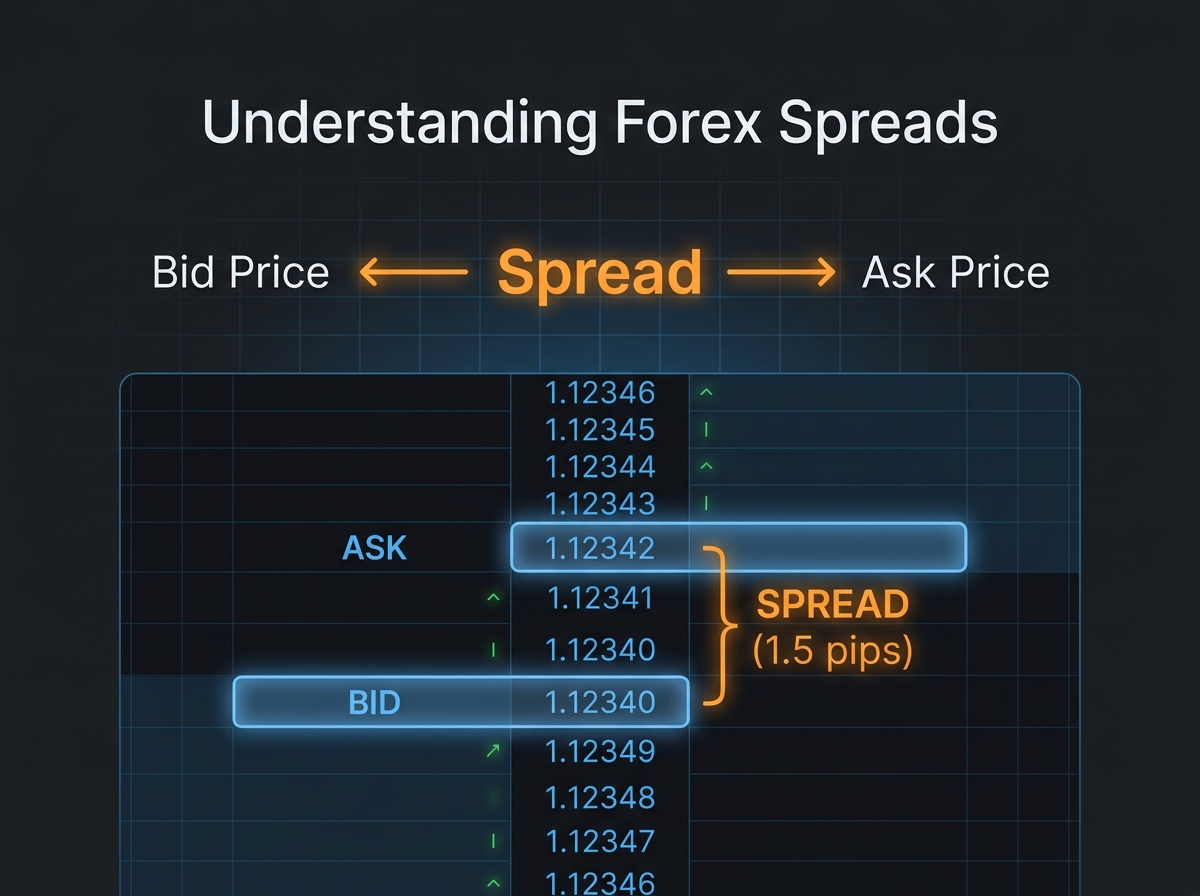
The spread is the most common way forex brokers earn money.
Whenever you look at a currency pair, you\'ll notice two prices displayed:
Bid Price
This is the highest price someone is currently willing to buy the currency pair.
Ask Price
This is the lowest price someone is willing to sell it.
The difference between these two prices is called the spread.
For example:
EUR/USD
Bid: 1.10500
Ask: 1.10515
Spread = 1.5 pips
When you buy EUR/USD, you automatically enter the trade at the higher Ask price.
If you immediately closed that trade, you would exit at the lower Bid price.
That difference is how the broker earns compensation.
Think of it like exchanging currency at an airport.
If the airport buys dollars from you at ₦1,580 but sells them for ₦1,600, the ₦20 difference is effectively its spread.
Forex brokers operate using the same principle, except spreads are measured in pips rather than physical cash.
Fixed vs Floating Spreads
Some brokers offer fixed spreads that remain relatively constant regardless of market conditions.
Others offer floating spreads that change continuously depending on market liquidity.
During major economic announcements such as U.S. Non Farm Payrolls or central bank decisions, floating spreads often widen significantly because liquidity temporarily decreases.
Understanding this helps explain why your trading costs may increase during periods of high volatility.
2. Commission Fees
Instead of increasing the spread, many professional brokers charge a separate commission.
This model is popular among active traders because it often provides access to extremely tight spreads.
Imagine two brokers:
Broker A
Spread = 1.8 pips
Commission = None
Broker B
Spread = 0.2 pips
Commission = $7 per standard lot
Although Broker B charges a commission, the overall trading cost may actually be lower.
Professional traders rarely evaluate spreads alone.
Instead, they compare the all-in trading cost, which includes both the spread and any commission charged.
This is especially important for scalpers and day traders who execute dozens of trades each day.
A seemingly small difference of half a pip can significantly impact profitability over hundreds of trades.
Image Suggestion 11
Title: Spread Only vs Commission Model
Create two comparison boxes.
Left:
Broker A
Spread: 1.8 pips
Commission: $0
Right:
Broker B
Spread: 0.2 pips
Commission: $7
Highlight total trading cost beneath each.
3. Swap or Overnight Financing Charges
Forex trading uses borrowed capital through leverage.
When you keep a leveraged position open overnight, your broker may apply what\'s known as a swap fee, also called a rollover or overnight financing charge.
This fee reflects the interest rate difference between the two currencies in the pair, adjusted for the broker\'s financing costs and pricing.
For example, if you\'re long on a currency with a higher interest rate while short a currency with a lower interest rate, you might receive a positive swap. In the opposite scenario, you may pay a negative swap. The actual amount depends on current market interest rates, your broker\'s calculations, the position size, and how long the trade remains open.
Many beginners mistake swap charges for hidden fees, but they are a standard feature of leveraged forex trading. However, swap calculations vary from broker to broker, so it\'s worth reviewing your broker\'s published swap rates.
Image Suggestion 12
Title: How Overnight Swaps Work
Illustrate:
Open Trade
↓
Held Overnight
↓
Interest Calculation
↓
Positive Swap
or
Negative Swap
Understanding Order Execution
When you click the Buy or Sell button, your trade does not instantly appear inside the global banking system.
Instead, your broker first decides what to do with that order.
This decision is called order execution.
Think of a restaurant.
You order food.
The waiter doesn\'t cook it.
Instead, the waiter decides where your order goes.
Perhaps to the grill.
Perhaps to the pizza oven.
Perhaps to the dessert station.
Similarly, brokers decide where your order is routed.
That routing depends entirely on their execution model.
A-Book Execution
One of the most transparent execution methods is known as A-Book execution.
Under this model, the broker does not take the opposite side of your trade.
Instead, it passes your order directly to an external liquidity provider, which may be a bank, a non-bank market maker, or another institutional counterparty.
If you buy EUR/USD, the broker sends your order onward rather than holding the market risk itself.
The broker acts much like an agent connecting you to available liquidity.
Its primary goal is to provide access to the market and earn revenue from spreads, commissions, or both, rather than from whether you win or lose.
Why Many Traders Prefer A-Book Brokers
Because the broker does not generally profit from client trading losses under this model, some traders believe there is less potential for conflicts of interest.
However, A-Book execution is not automatically better in every situation.
Your trade still depends on:
Liquidity available at that moment
Market volatility
Execution technology
Slippage
Network latency
Even with direct market routing, you may receive a different execution price than the one displayed on your screen if prices move quickly.
Image Suggestion 13
Title: A-Book Execution Flow
Diagram:
Trader
↓
Forex Broker
↓
Liquidity Provider
↓
Interbank Market
Use blue directional arrows with institutional banking icons.
How A-Book Brokers Make Money
If an A-Book broker passes every order to a liquidity provider, how does it remain profitable?
The answer is straightforward.
It earns revenue from the services it provides.
Typical income sources include:
Trading commissions
Small markups added to institutional spreads
Overnight financing charges
Currency conversion fees
Premium account services
For example:
Suppose a liquidity provider quotes EUR/USD with a spread of 0.2 pips.
The broker may present that quote to clients as 0.5 pips.
The additional 0.3 pip markup becomes part of the broker\'s revenue.
Similarly, if the broker charges a commission of $3.50 per side on a standard lot, those commissions accumulate over thousands of daily trades.
This business model resembles a travel agency.
The agency does not own the airline, but it earns money by facilitating the booking.
Likewise, an A-Book broker facilitates access to the market rather than taking ownership of the market risk.
Image Suggestion 14
Title: How an A-Book Broker Earns Revenue
Illustrate:
Liquidity Provider
↓
Institutional Spread
↓
Broker Adds Small Markup
↓
Trader Pays Final Spread
Include commission icons and revenue arrows.
Challenges of A-Book Execution
Although A-Book execution is often viewed as transparent, it is not without challenges.
Because the broker passes trades to external liquidity providers, it must pay those providers for execution.
This means the broker\'s profitability depends heavily on trading volume. If client activity declines, revenue may also decrease.
Execution quality can also vary during periods of extreme volatility. Liquidity providers may widen spreads, reject orders, or fill trades at different prices than requested, resulting in slippage.
Maintaining multiple liquidity relationships, investing in high-speed infrastructure, and meeting regulatory obligations also increases operating costs.
For these reasons, A-Book brokers must carefully balance competitive pricing with sustainable business operations.
Dipprofit Trading AcademySchool of Forex
● Free & Premium Curriculum
Global market knowledge, trade with zero guesswork.
Dipprofit Trading Academy takes you from "what is a pip" to full price-action trading, with graded quizzes, a live leaderboard, and a certificate at the finish line.
Your Overall Progress
—
Sign in to start tracking your progress, rank on the leaderboard, and get a certificate of completion.
📊
Real Progress TrackingEvery quiz score builds your standing
🏆
Global & Level LeaderboardsSee exactly where you rank
🎓
Certificate on CompletionFinish every level, earn your proof
Curriculum
Your path through the School of Forex
"View Lessons" previews a level right here. "Start Lesson" takes you straight into it.