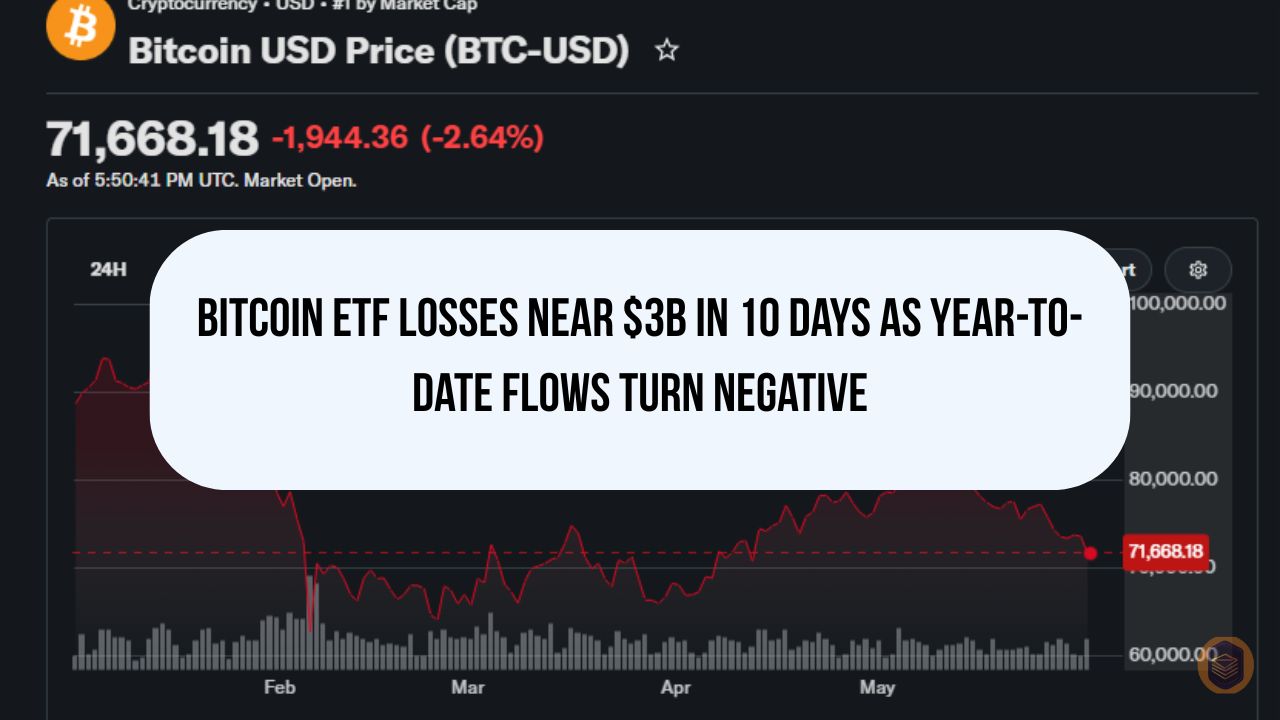

Bitcoin exchange-traded funds have suffered significant outflows over the past 10 days, with losses approaching $3 billion as investor sentiment shifts. The downturn has pushed year-to-date flows into negative territory, marking a sharp reversal from the optimism that surrounded the approval of spot Bitcoin ETFs earlier this year. Bitcoin itself has declined to $72,639, down 1.60% in recent trading, reflecting broader market weakness across digital assets.
The timing of these outflows coincides with broader cryptocurrency market pressure, as major altcoins also posted losses. Ethereum fell 1.78% to $1,983.35, while Solana dropped 1.95% to $81.01. This follows a pattern seen in Bitcoin slipping under $73K as the crypto market faces nearly $1B in liquidations, suggesting institutional and retail investors are reassessing their positions simultaneously.

The shift in ETF flows represents a notable change in market dynamics. Earlier in 2026, spot Bitcoin ETFs attracted consistent inflows following their regulatory approval, drawing both institutional and retail capital into the space. However, the recent reversal indicates that investor confidence may be wavering amid macroeconomic headwinds or profit-taking after significant gains.
According to data from CoinGecko, the broader cryptocurrency market has experienced volatility, with some assets posting double-digit losses while others remain relatively stable. Stablecoins like USDC and various USD-pegged tokens held their value, suggesting investors may be moving capital to the sidelines rather than exiting crypto entirely.
See also: Retail Bitcoin Sentiment Still Matters Despite Institutional Inflows, Swan CEO Says
The $3 billion in losses across Bitcoin ETFs over just 10 days underscores the scale of the recent selloff. This magnitude of outflow is significant enough to impact market liquidity and potentially influence Bitcoin’s price action in the near term. Analysts have noted that such concentrated outflows can create cascading effects, particularly if they trigger stop-loss orders or margin liquidations.
Interestingly, not all digital assets moved in lockstep with Bitcoin and Ethereum. Some tokens posted gains, with HYPE rising 8.55%, WLD climbing 13.27%, and several others showing positive momentum. This divergence suggests that while macro sentiment has turned cautious, certain segments of the market retain buyer interest, particularly in emerging or speculative projects.
The negative year-to-date flows for Bitcoin ETFs stand in contrast to earlier predictions from some analysts who expected sustained institutional adoption throughout 2026. Retail Bitcoin sentiment still matters despite institutional inflows, according to Swan CEO, highlighting that both retail and institutional participants influence market direction. The recent outflows suggest that retail investors may be pulling back alongside institutions.
Market observers have pointed to several potential catalysts for the recent weakness. Macroeconomic concerns, including inflation data and interest rate expectations, have weighed on risk assets broadly. Additionally, regulatory developments and geopolitical tensions have added uncertainty to the crypto market outlook. Some analysts view the outflows as a healthy correction after strong early-year performance.
See also: Bitcoin Slips Under $73K as Crypto Market Faces Nearly $1B in Liquidations

The performance of Bitcoin ETFs carries broader implications for the cryptocurrency industry. These products serve as a key entry point for traditional investors, and sustained outflows could signal weakening institutional interest. Conversely, some market participants view significant outflows as contrarian signals, suggesting that capitulation may be near and recovery could follow.
Bitcoin’s current price of $72,639 remains substantially higher than levels seen in late 2023, but the recent decline has erased some of the gains accumulated since the start of 2026. The cryptocurrency’s volatility continues to reflect its status as a risk asset, moving in tandem with broader equity market sentiment and macroeconomic expectations.
Looking ahead, market participants will be watching ETF flows closely as a barometer of institutional sentiment. A stabilization or reversal of outflows could signal renewed confidence, while continued withdrawals might indicate deeper concerns about near-term price direction. The coming weeks will likely prove critical in determining whether the recent weakness represents a temporary pullback or the beginning of a more sustained downturn.
If you’re reading this, you’re already ahead. Stay there, by joining the…
Discover more from Dipprofit
Subscribe to get the latest posts sent to your email.