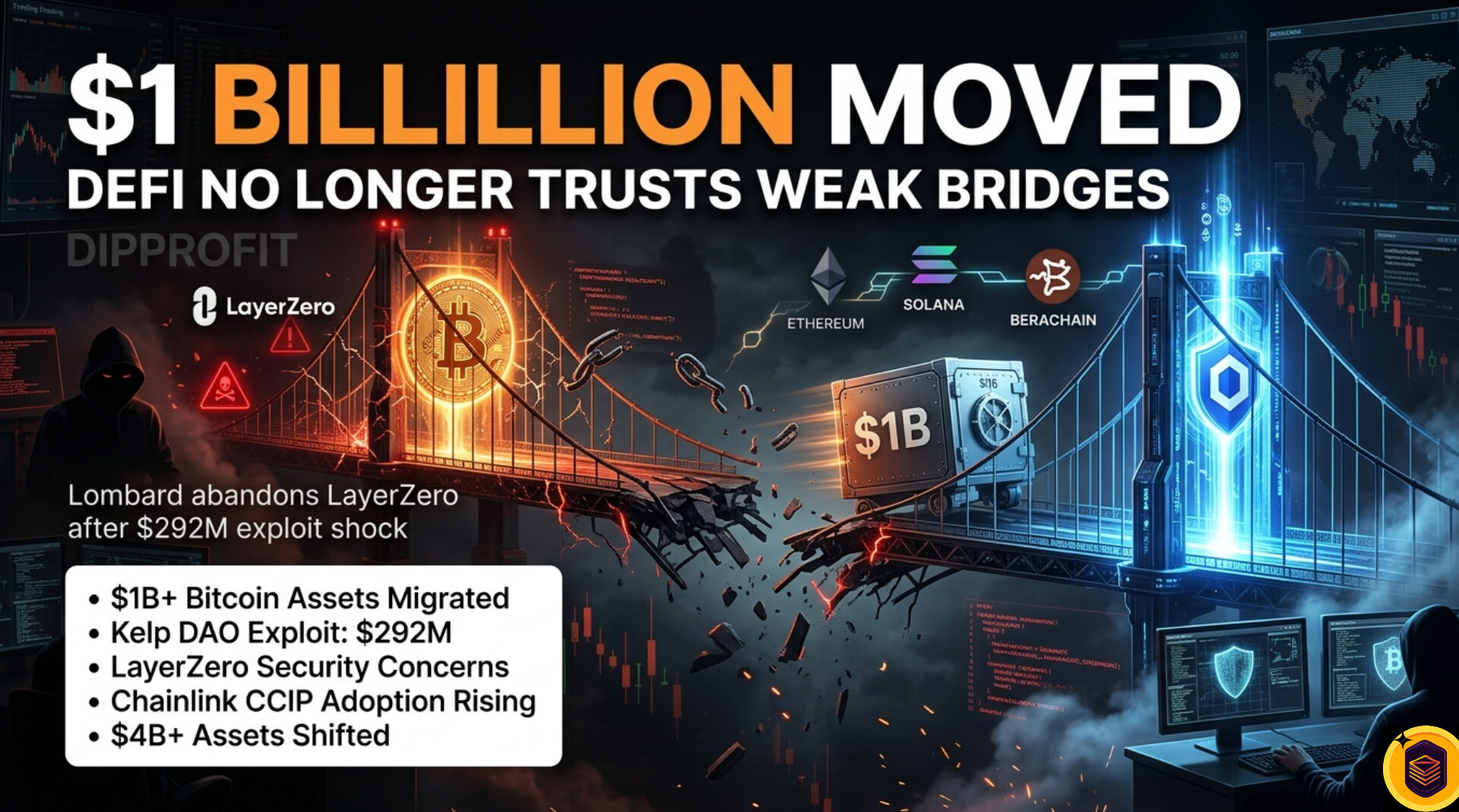

This week, Bitcoin DeFi protocol Lombard Finance announced it is abandoning LayerZero in favor of Chainlink infrastructure to secure more than $1 billion worth of Bitcoin-backed assets spread across Ethereum, Solana, Berachain, and other networks.
The move is not just another technical upgrade buried inside crypto jargon. It is a loud signal that confidence in cross-chain security has been shaken at the highest levels of DeFi.
And it all traces back to the Kelp DAO disaster.
In April, hackers drained roughly $292 million from Kelp DAO infrastructure tied to LayerZero-powered bridge systems. The incident sent shockwaves through the market because bridges are supposed to do one thing above all else: move assets safely between blockchains.
LayerZero later admitted that an internal configuration created risks the company “simply didn’t see.” According to postmortem details, internal RPC infrastructure was reportedly poisoned by North Korean attackers, opening the door to one of the largest bridge-related security failures of the year.
For Lombard Finance, that was enough.
The company said it conducted a full internal review before deciding to migrate completely to Chainlink’s Cross-Chain Interoperability Protocol, better known as CCIP. In a public statement, Lombard said the decision was driven by one priority: protecting users and preserving the protocol’s spotless security history.
That matters because Lombard is not a small experimental project operating in crypto’s shadows.
Its flagship assets, Lombard BTC and Lombard Staked BTC (LBTC) collectively represent over $1 billion in market capitalization, with LBTC alone accounting for more than $800 million. The token is designed to function like a liquid staking asset while remaining fully backed 1:1 by Bitcoin.
In plain English, users deposit Bitcoin and receive a token they can move across DeFi ecosystems without selling their BTC exposure.
That business only works if trust exists.
And right now, trust in bridge infrastructure has become crypto’s newest battlefield.
Lombard is not alone in leaving LayerZero behind. Crypto exchange Kraken recently made the same decision for its wrapped Bitcoin product, kBTC. Other protocols including Solv, Re.xyz, and Kelp DAO itself have also migrated away from LayerZero systems in recent weeks. Analysts tracking the movement estimate that more than $4 billion in assets have now shifted toward Chainlink CCIP infrastructure.
The sudden migration is turning Chainlink into something far bigger than just the oracle network many traders remember from earlier market cycles.
For years, Chainlink was mostly known for feeding real-world data into smart contracts. Now it is positioning itself as the backbone of institutional-grade blockchain communication, the digital plumbing connecting an entire ecosystems together.
And institutions appear to be paying attention.
Chainlink’s CCIP infrastructure now boasts ISO 27001 and SOC 2 Type 2 certifications, credentials that resonate strongly with enterprises entering blockchain markets. The network also claims to have facilitated more than $28 trillion in cumulative transaction value.
That kind of scale changes the conversation.
For years, crypto prioritized speed, innovation, and growth above almost everything else. Security was often treated as something teams could improve later. But the industry has matured the hard way through collapsed exchanges, bridge hacks, and billion-dollar failures.
Now the market is demanding infrastructure that looks less like a startup experiment and more like financial-grade architecture.
The irony is impossible to ignore.
Cross-chain technology was originally built to make crypto feel borderless and seamless. Instead, bridges have become some of the most dangerous pressure points in the entire ecosystem, repeatedly targeted by sophisticated hackers because they hold enormous pools of locked liquidity.
Lombard’s departure from LayerZero may not crash markets or trigger panic selling. But it reveals something deeper happening beneath the surface of crypto right now.
The industry is quietly entering a new phase where survival depends less on hype and more on reliability.
And in this market, trust may become the most valuable asset of all.
More Reads:
Bitcoin Holds the Line as Wall Street Blinks
THORChain Halts Trading After Suspected A $10 Million Exploit
Discover more from Dipprofit
Subscribe to get the latest posts sent to your email.