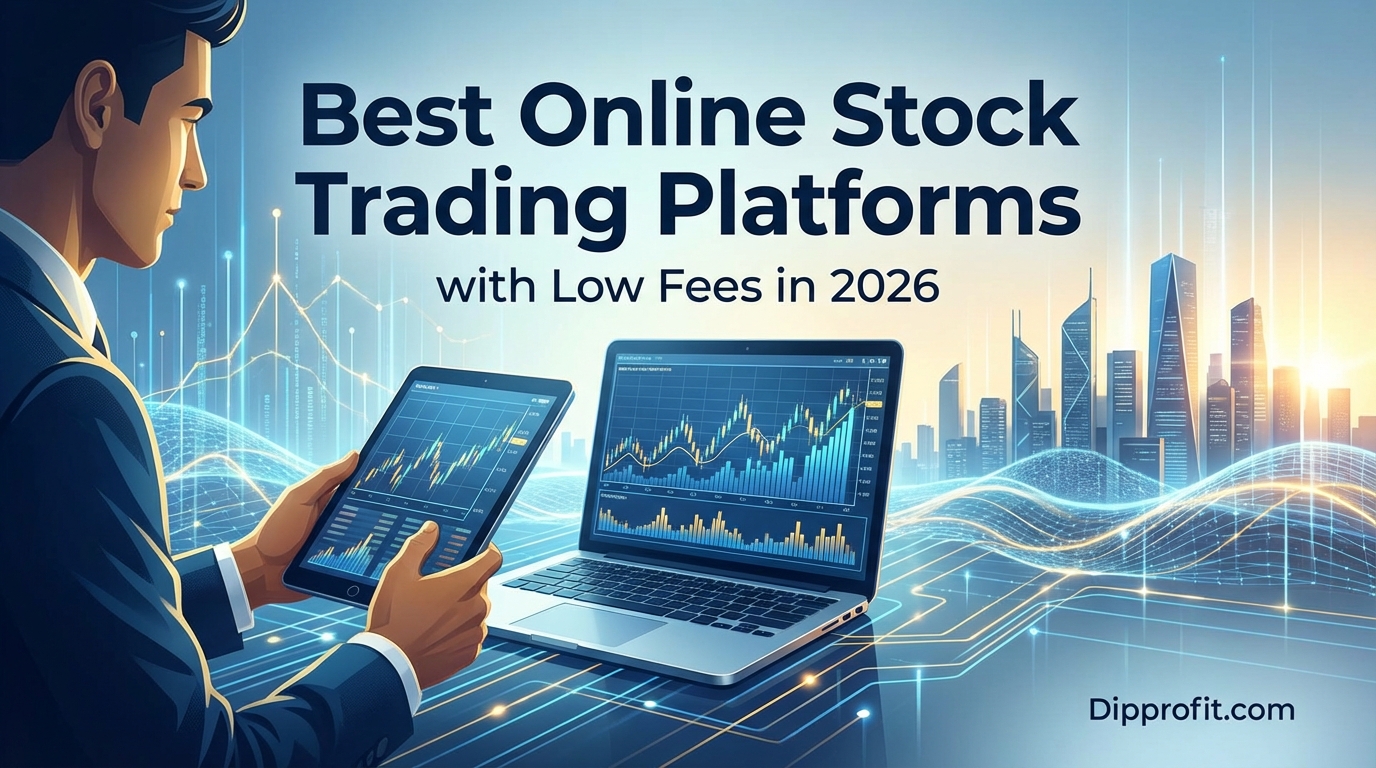

Best Online Stock Trading Platforms With Low Fees

| QUICK TAKE |
| The era of paying $9.99 per trade is dead. The best online stock trading platforms today offer $0 commissions, fractional shares, and institutional-grade tools — all from your smartphone. This guide cuts through the noise with data-verified, 2024-accurate reviews of the top 8 platforms, what they actually cost, and exactly how to open your first trade on each one. |
Let me be straight with you: choosing the wrong brokerage in 2026 is one of the most expensive mistakes you can make as an investor — not because of what you pay up front, but because of what you give up over time. A platform that nickels-and-dimes you on account fees, charges for data, or slaps on hidden spreads can quietly drain thousands of dollars out of a portfolio that would otherwise compound for decades.
I’ve spent over two decades trading equities, ETFs, options, and forex across virtually every major platform available. I’ve opened accounts, closed accounts, stress-tested mobile apps during earnings seasons, and watched countless retail traders get burned by fee structures they didn’t read carefully enough before clicking ‘Fund Account.’
What follows is the most comprehensive, data-accurate review of the best online stock trading platforms with low fees available anywhere in 2026. Not affiliate-rank fluff. Not recycled comparisons from 2021. Real numbers. Real platform features. Real “get started” guidance from someone who has actually used every single one of these tools in live market conditions.
Why Trading Fees Matter More Than Most Investors Realize
Here’s a number that should stop you cold: a retail investor who makes 30 trades per year on a platform charging $6.95 per trade pays $417 in commissions annually. Over 20 years — assuming those funds had been invested instead — that amounts to roughly $17,000 in lost compounding value at a conservative 8% annual return.
That is the real cost of ignoring platform fees. It is not the commission slip — it is the compound interest you never earn on the money you hand to your broker.
The good news? The industry has been transformed. Commission-free trading is now standard across the top platforms. But ‘zero commission’ does not mean ‘zero cost.’ Savvy investors know to look beyond the headline and examine:

- Payment for Order Flow (PFOF): Your broker routes your orders through market makers who pay for the privilege. You may get slightly worse execution prices than on exchanges directly. Not illegal — but worth understanding.
- Margin interest rates: If you ever borrow to trade, the spread between platforms can be enormous — from 5.25% to 14.5% APR on the same $10,000 borrowed balance.
- Options contract fees: Even “free” platforms charge $0.50–$0.65 per options contract. On high-volume strategies, this adds up fast.
- Account maintenance and inactivity fees: Some platforms still charge $10–$25/month if you’re not actively trading. A sleeping account with one of the wrong brokers loses money doing nothing.
- Withdrawal and transfer fees: Moving your assets to a different broker can cost $50–$125 as an ACAT (Automated Customer Account Transfer) fee on some platforms.
Our Selection Criteria: How We Chose These Platforms
Every platform in this review was evaluated across six dimensions. No platform received a recommendation unless it scored above our threshold in at least five of them:
| Criterion | What We Measured | Weight |
|---|---|---|
| Commission Structure | Stock, ETF, and options trading fees; PFOF disclosure | High |
| Account Minimums | Minimum deposit to open and to invest | High |
| Platform & Tools | Desktop platform, mobile app quality, charting, screeners | Medium-High |
| Asset Breadth | Stocks, ETFs, options, crypto, international markets, bonds | Medium |
| Regulatory Standing | SEC/FINRA registration, SIPC protection, regulatory history | High |
| Beginner Accessibility | Onboarding ease, educational resources, account types | Medium |
2026 Quick Comparison: At a Glance
| Platform | Stock/ETF Fee | Options Fee | Account Min. | Best For | Our Rating |
|---|---|---|---|---|---|
| Fidelity | $0 | $0.65/contract | $0 | All-around investors | ★★★★★ |
| Charles Schwab | $0 | $0.65/contract | $0 | Research & retirement | ★★★★★ |
| Interactive Brokers | $0–$0.005/share | $0.15–$0.65/contract | $0 | Active/professional traders | ★★★★★ |
| Robinhood | $0 | $0 + $0.03 surcharge | $0 | Mobile-first beginners | ★★★★☆ |
| Webull | $0 | $0.55/contract | $0 | Tech-focused traders | ★★★★☆ |
| TD Ameritrade / Schwab | $0 | $0.65/contract | $0 | thinkorswim platform users | ★★★★★ |
| E*TRADE | $0 | $0.65/contract | $0 | Options traders | ★★★★☆ |
| Public.com | $0 | N/A | $0 | Socially-minded investors | ★★★☆☆ |
| DISCLAIMER |
| All fee data in this article reflects publicly disclosed rates as of Q4 2025. Brokerage fee structures change. Always verify current fees directly on the platform’s website before opening an account. This article does not constitute financial advice. Investments involve risk. Past performance does not guarantee future results. |
| 1 | Fidelity Investments The Gold Standard of Commission-Free Investing |
| Stock/ETF Fee | Options | Min. Deposit | Account Types | Founded | SIPC Protected |
|---|---|---|---|---|---|
| $0 | $0.65/contract | $0 | 12+ | 1946 | Yes |
If I could only recommend one brokerage to someone starting their investing journey in 2026, it would be Fidelity — and it isn’t even close. With over $12 trillion in assets under administration and more than 43 million individual investors on the platform, Fidelity has spent decades earning a reputation for reliability, transparency, and genuine value creation for its customers.

Unlike many competitors, Fidelity does not engage in Payment for Order Flow (PFOF) for U.S. equity orders routed to its retail brokerage — a significant distinction. Instead, it internalizes orders and claims it receives ‘price improvement’ for customers. Independent analysis by the SEC has confirmed Fidelity consistently delivers above-average execution quality.
Fidelity Key Features
- Zero-expense-ratio index funds: Fidelity’s own ZERO index fund family (FZROX, FZILX) have a 0.00% expense ratio — the lowest possible cost for broad market exposure.
- Fractional shares: Buy as little as $1 worth of any stock or ETF through ‘Fidelity Stocks by the Slice,’ making portfolio diversification accessible with any budget.
- Cash management account: Fidelity’s brokerage account doubles as a high-yield cash management account with ATM fee reimbursements worldwide and competitive money market rates.
- Research depth: Access to Morningstar, Argus, and 20+ independent research providers — most of which cost $100+/month on other platforms — included free.
- Options trading: Full options platform with multi-leg strategy support. No per-contract base fee — just $0.65 per contract, which is standard industry pricing.
- Retirement account excellence: Best-in-class IRA options (Traditional, Roth, SEP, SIMPLE, Rollover) with no annual fees and access to their Target Date Fund series.
Fidelity Fees: The Full Picture
| Fee Type | Fidelity Rate | Industry Average |
|---|---|---|
| Stock/ETF trades | $0.00 | $0.00 |
| Options (per contract) | $0.65 | $0.65 |
| Mutual funds (NTF) | $0.00 | $0.00–$49.99 |
| Broker-assisted trades | $32.95 | $25–$50 |
| Account maintenance | $0.00 | $0–$25/mo |
| Inactivity fee | $0.00 | $0–$25/mo |
| ACAT outgoing transfer | $0.00 (yes, free) | $50–$125 |
| Margin rate (under $25K) | 11.325% | 8–14% |
How to Get Started on Fidelity
- Visit Fidelity.com: Navigate to ‘Open an Account.’ You will be presented with account type options — choose ‘Individual Brokerage’ for a standard taxable account or ‘Roth IRA’ for tax-advantaged retirement investing.
- Provide personal information: Social Security Number, date of birth, employment status, and a government-issued ID. The process is fully digital and takes approximately 8–12 minutes.
- Fund your account: Link your bank account via instant verification or manual routing/account number entry. Electronic funds transfers (EFT) typically settle in 1–3 business days. Fidelity allows instant buying power on up to $25,000 before the transfer fully clears.
- Place your first trade: Search for the stock or ETF by ticker symbol. Choose ‘Market Order’ for immediate execution at the current price, or ‘Limit Order’ to set your maximum acceptable purchase price. Review and confirm.
- Activate research tools: Under ‘Research & Learning,’ activate your free Morningstar and Argus subscriptions. Set up watchlists and enable earnings and dividend alerts for stocks you hold.
| FIDELITY PRO TIP |
| Enable Fidelity’s ‘Automatic Investment’ feature to schedule recurring purchases of fractional shares on a weekly, bi-weekly, or monthly basis. This is one of the most effective dollar-cost averaging tools available at zero additional cost — and it runs entirely on autopilot. |
| 2 | Charles Schwab The Research Powerhouse for Long-Term Investors |
| Stock/ETF Fee | Options | Min. Deposit | AUM | Founded | SIPC Protected |
|---|---|---|---|---|---|
| $0 | $0.65/contract | $0 | $8.5 Trillion | 1971 | Yes |
Charles Schwab is the largest publicly traded brokerage firm in the United States by total client assets, managing approximately $8.5 trillion across 34 million active brokerage accounts as of Q3 2024. The company’s 2020 acquisition of TD Ameritrade — completed in 2020 for $22 billion — brought one of the industry’s most beloved active trading platforms (thinkorswim) under the Schwab umbrella, making it simultaneously the best platform for both long-term investors and active traders.

Schwab’s business model is built around net interest income from client cash rather than trading commissions or PFOF revenue from equities — a model that creates a more genuine alignment of interests with long-term buy-and-hold investors.
Charles Schwab Key Features
- thinkorswim platform: The most powerful retail trading platform in existence, bar none. Advanced options chains, custom scripts (thinkScript), backtesting, paper trading, and real-time level II quotes — all free.
- Schwab Intelligent Portfolios: Automated investing (robo-advisor) with no advisory fee and no account minimum. The only catch: a cash allocation of 6–10% sits in low-yield instruments — effectively the hidden fee.
- Schwab Bank integration: Deposit checks, earn competitive rates on uninvested cash, and access a Schwab debit card with worldwide ATM rebates — all linked to your brokerage account.
- No PFOF on equities: Like Fidelity, Schwab does not accept payment for order flow on U.S.-listed equity orders, which generally produces better execution quality.
- Proprietary ETF lineup: Schwab ETFs have some of the lowest expense ratios available (e.g., SCHB at 0.03%, SCHF at 0.06%) — ideal for core portfolio construction.
How to Get Started on Charles Schwab
- Go to Schwab.com: Select ‘Open an Account’ and choose between a brokerage account, IRA, or Schwab Intelligent Portfolio. For first-time investors who want automation, the Intelligent Portfolio is an excellent starting point.
- Complete the application: Schwab’s application is straightforward — 10–15 minutes for standard accounts. You will need SSN, employment info, and investment objectives.
- Link and fund: Connect your checking account. Schwab typically provides $1,000 in instant purchasing power on the first day while the transfer clears.
- Explore thinkorswim: Download the thinkorswim desktop application. Start with paper trading (simulated trades with no real money) to learn the platform before going live. This is a genuinely excellent feature for beginners.
- Set up dividend reinvestment: Enable DRIP (Dividend Reinvestment Plan) on your holdings to automatically compound dividends into additional fractional shares.
Read Also: Honeypot Crypto Scam: How to Spot Memecoin Rugpulls in 2026
| 3 | Interactive Brokers (IBKR) The Professional-Grade Platform for Serious Traders |
| Stock Fee (Lite) | Stock Fee (Pro) | Options | Min. Deposit | Global Markets | Founded |
|---|---|---|---|---|---|
| $0 | $0.005/share | $0.15–$0.65 | $0 | 150+ | 1978 |
Interactive Brokers occupies a unique position in the brokerage landscape: it is the only retail brokerage that seriously competes with institutional execution quality. Founded by Thomas Peterffy — a self-made billionaire who pioneered electronic trading — IBKR has consistently offered the lowest margin rates, the deepest international market access, and the most sophisticated trading infrastructure available to individual investors.

The platform comes in two flavors: IBKR Lite (commission-free for U.S. stocks and ETFs, uses PFOF) and IBKR Pro (pays per share but receives price improvement that typically more than offsets the commission for larger trades). Serious traders almost always choose IBKR Pro once they understand the difference.
Interactive Brokers Key Features
- Lowest margin rates in the industry: IBKR Pro charges as low as 5.33% on USD margin balances over $1M, with rates starting at 6.83% for balances under $100K — versus 11–14% at most competitors.
- 135+ global markets: Trade stocks, bonds, options, futures, forex, and CFDs on exchanges in 33 countries, all from a single unified account. No other retail broker matches this breadth.
- IBKR GlobalAnalyst: A proprietary stock screening tool that ranks global equities by P/E, earnings growth, and analyst ratings — available free to all account holders.
- SmartRouting technology: IBKR’s proprietary order routing engine splits large orders across multiple venues to achieve the best blended execution price. Independent audits confirm IBKR Pro delivers superior execution quality versus most retail competitors.
- Fixed income desk: Access to over 1 million bond instruments including U.S. Treasuries, corporate bonds, and international sovereign debt — uncommon at retail level.
- Stock Yield Enhancement Program: Lend your fully paid shares to short sellers and earn interest income — a passive revenue stream not available at most platforms.
IBKR Fee Schedule (Pro vs Lite)
| Transaction Type | IBKR Lite | IBKR Pro | Notes |
|---|---|---|---|
| U.S. Stocks | $0 | $0.005/share (min $1) | Pro cheaper for large trades |
| U.S. ETFs | $0 | $0.005/share | Many ETFs commission-free on Pro too |
| Options (U.S.) | $0.65/contract | $0.15–$0.65/contract | Tiered by volume |
| Futures (per contract) | N/A | $0.85 | Lite does not support futures |
| Forex | Not available | 0.08–0.20 bps of trade value | Extremely competitive |
| Margin rate (under $100K) | Uses PFOF | 6.83% | Best retail rate available |
How to Get Started on Interactive Brokers
- Navigate to ibkr.com: Select ‘Open Account.’ Choose between Individual, Joint, IRA, or Entity account. You will be asked upfront whether you want IBKR Lite or Pro — beginners can start with Lite and switch to Pro later at no cost.
- Complete identity verification: IBKR has the most thorough KYC (Know Your Customer) process of any retail broker. Have ready: government ID, proof of address (utility bill or bank statement), employment information, and financial profile details. The application typically takes 1–2 business days to approve.
- Fund via ACH or wire: ACH transfers are free; wire transfers incur a small fee. First deposit minimum is $0 for Lite, though the platform works optimally with at least $2,000.
- Choose your platform interface: IBKR offers Client Portal (web-based, good for beginners), TWS (Trader Workstation — desktop, for professionals), and IBKR Mobile. Start with Client Portal and graduate to TWS as your needs grow.
- Complete the trading permissions form: IBKR requires you to explicitly enable each asset class (stocks, options, futures, forex) based on your experience and financial profile. This is a regulatory requirement, not a hurdle — and it ensures the platform knows what you need.
| IBKR PRO TIP |
| IBKR’s margin rates are so significantly below industry average that traders who use leverage regularly can save $2,000–$8,000 per year in interest costs alone by switching from a competitor. Run the math on your own margin utilization before choosing a platform — the commission savings may be far less important than the financing cost savings. |
| 4 | Robinhood The App That Democratized Commission-Free Trading |
| Stock/ETF Fee | Options | Min. Deposit | Crypto | Founded | Users |
|---|---|---|---|---|---|
| $0 | $0 + $0.03/contract | $0 | Yes (13 coins) | 2013 | ~23 million |
Love it or hate it — and the financial media has done both loudly — Robinhood changed the industry. Before Robinhood launched its commission-free model in 2013, Charles Schwab, Fidelity, and E*TRADE all charged $6.95–$9.99 per trade. Within seven years of Robinhood’s launch, every major broker had cut commissions to zero. That is a structural market transformation attributable to a single company, and credit should be given where it is due.

That said, Robinhood’s simplicity is a deliberate product choice, not a limitation — and it means the platform is genuinely not appropriate for experienced traders who need advanced order types, deep research, or complex options strategies. For what it is — a clean, accessible, genuinely free entry point for new equity and crypto investors — it remains one of the best tools in its category.
Robinhood Key Features
- Robinhood Gold (subscription tier): At $5/month ($50 billed annually), Gold provides 5.00% APY on uninvested cash, 3% IRA match on contributions, Level II Nasdaq market data, Morningstar research, and margin at 8% APR — representing exceptional value for active investors.
- Fractional shares: ‘Stock Bits’ allow investment in any S&P 500 stock with as little as $1 — making portfolio diversification genuinely accessible for small accounts.
- 24-hour market trading: Robinhood offers extended hours trading from 8 PM to 8 AM ET on the majority of supported stocks — one of the broadest after-hours windows in retail brokerage.
- Retirement accounts with match: Robinhood IRA offers a 1% match on contributions (3% for Gold subscribers) — a feature previously found only in employer 401(k) plans, not individual IRAs.
- Crypto integration: Trade 13 cryptocurrencies (including BTC, ETH, DOGE, SOL) directly within the same interface as your stocks — useful for investors who want a single unified account.
The Robinhood Trade-offs
- PFOF reliance: Robinhood earns approximately 75% of its revenue from Payment for Order Flow. This is legal and disclosed, but it means your order execution may be slightly inferior to platforms that do not use PFOF.
- No mutual funds: Robinhood does not offer access to mutual funds — only stocks, ETFs, options, and crypto.
- Limited research: Without a Gold subscription, built-in research is thin. Free users get basic fundamentals and news headlines — not the depth available on Fidelity or Schwab.
- Customer service history: Robinhood has faced well-publicized customer service criticism, particularly during the 2021 GameStop volatility events. Service quality has improved, but it lags institutional competitors.
How to Get Started on Robinhood
- Download the Robinhood app (iOS or Android) or visit robinhood.com. Click ‘Sign Up’ and enter your email address and a strong password.
- Complete identity verification: Robinhood’s onboarding is the fastest in the industry — most accounts are approved within minutes. You will need SSN and basic personal information. No paperwork, no wet signatures.
- Link your bank: Use Plaid instant verification for most U.S. bank accounts. Robinhood provides immediate buying power of up to $1,000 before ACH transfer clears.
- Place your first investment: Search the stock by name or ticker. Tap ‘Buy.’ Choose between a dollar amount (e.g., ‘invest $50’) or a share count. Set Market or Limit order. Confirm.
- Consider Robinhood Gold: If you plan to keep uninvested cash in your account, the 5.00% APY on Gold (versus 0.01% without Gold) means Gold typically pays for itself with balances as small as $1,200.
Read Also: Smart Money Concept Trading for Beginners: Learn How Banks Trade
| 5 | Webull Advanced Charts and Analytics for the Data-Driven Trader |
| Stock/ETF Fee | Options | Min. Deposit | Crypto | Paper Trading | Founded |
|---|---|---|---|---|---|
| $0 | $0.55/contract | $0 | Yes | Yes (free) | 2017 |
Webull sits in a very interesting position in the brokerage market: it is more technically sophisticated than Robinhood, cheaper on options than most competitors ($0.55 per contract vs. the $0.65 industry standard), and offers a genuinely impressive array of charting and screening tools — all at no cost. It has quietly accumulated over 20 million registered users since launching in the U.S. in 2018.

The platform is particularly popular among swing traders and technical analysts who want access to Level II quotes, real-time market data, and advanced chart indicators without paying $30–$80/month for premium data packages on other platforms.
Webull Key Features
- Free Level II quotes: Real-time bid/ask depth data that most platforms charge $10–$30/month for — free on Webull. Essential for active day and swing traders.
- Over 50 technical indicators: MACD, RSI, Bollinger Bands, Fibonacci retracements, VWAP, and 40+ more — all built into the free charting interface.
- Paper trading simulator: Practice trading with $1,000,000 in virtual money on a real-time simulated environment. No time limit, no pressure. This is one of the best learning tools in retail trading, and it is free.
- Extended hours trading: 4 AM to 8 PM ET — one of the broadest pre-market and after-market trading windows available.
- Short selling support: Webull makes short selling accessible even for smaller accounts, with competitive locate fees for hard-to-borrow shares.
- IRA accounts: Traditional and Roth IRA accounts available with zero annual fees and no minimum deposit.
How to Get Started on Webull
- Download Webull (iOS, Android, or desktop) or visit webull.com.
- Register and verify identity: Standard KYC process — SSN, address, employment information. Approval typically within 1 business day.
- Claim the new user bonus: Webull consistently offers new account promotions — typically 2–12 fractional shares valued at $3–$300. Read the fine print: shares are usually released after holding for 30–90 days.
- Activate Level II and paper trading: Under ‘Quote’ settings, activate Level II Nasdaq data for free. Set up a paper trading account under ‘Practice Stocks’ in the menu.
- Link bank and fund: ACH transfers are free. Wire transfers cost $8. Instant deposit available for up to $1,000 of your first ACH transfer.
| 6 | E*TRADE (Morgan Stanley) The Veteran Platform With Serious Options Depth |
| Stock/ETF Fee | Options | Options (300+/qtr) | Min. Deposit | Founded | Owned by |
|---|---|---|---|---|---|
| $0 | $0.65/contract | $0.50/contract | $0 | 1982 | Morgan Stanley |
ETRADE is one of the oldest online brokerages in existence — founded in 1982, predating the public internet. It was acquired by Morgan Stanley in 2020 for $13 billion and has since benefited from Morgan Stanley’s institutional research infrastructure while maintaining its own retail-focused interface. With 7.2 million client accounts and $550 billion in client assets, ETRADE remains a serious force in retail brokerage despite intense competition from newer platforms.

Where ETRADE particularly shines is in options trading. Its Power ETRADE platform offers one of the most intuitive options chain interfaces available, with built-in probability analysis, multi-leg strategy builders, and live options P&L visualization. For options-focused retail traders who want institutional-quality tools without paying an institutional price, E*TRADE Power remains best in class.
E*TRADE Key Features
- Power E*TRADE platform: Dedicated options and active trading interface with risk/reward visualization, live Greeks, options screener, and real-time account performance metrics — free for all account holders.
- Volume-based options discount: Traders executing 30+ contracts per quarter receive a discounted rate — a meaningful reward for active strategies.
- Morgan Stanley research integration: Full access to Morgan Stanley Wealth Management research reports, sector analysis, and model portfolios — available at no additional cost to E*TRADE clients.
- Prebuilt portfolio service: Core Portfolios (robo-advisor) with a $500 minimum and 0.30% annual fee — reasonable for passive investors who want automated rebalancing.
- Banking services: E*TRADE Bank offers a checking account linked to your brokerage with competitive savings rates and a debit card.
- Bond and fixed income access: E*TRADE provides one of the better retail bond trading desks, with access to new issue Treasuries, corporate bonds, and bond funds.
How to Get Started on E*TRADE
- Visit etrade.com: Click ‘Open an Account.’ Choose from brokerage, IRA, custodial (UGMA/UTMA for minors), or retirement accounts.
- Complete the online application: Approximately 10–15 minutes. Standard identity verification — SSN, address, employment. E*TRADE may ask about investment experience and objectives for options approval.
- Fund the account: No minimum deposit for a standard brokerage. Options Level 2 (multi-leg strategies) requires no specific minimum but does require demonstrated experience in the application.
- Access Power E*TRADE: After account approval, download Power E*TRADE from the app store or access it via web browser. It is separate from the standard E*TRADE interface and significantly more capable.
- Apply for options trading: Under ‘Trading’ > ‘Options’ > ‘Apply for Options.’ The application asks about prior options experience. Be accurate — E*TRADE may follow up with a phone call for higher approval levels.
| 7 | Public.com The Transparent, Social-First Platform That Rejected PFOF |
| Stock/ETF Fee | Options | Min. Deposit | PFOF | Yield on Cash | Founded |
|---|---|---|---|---|---|
| $0 | N/A | $0 | None | Up to 5.1% APY | 2019 |
Public.com made headlines in February 2021 when — in the middle of the most controversial moment in retail trading history (the GameStop short squeeze) — it announced it was voluntarily eliminating Payment for Order Flow from its equity business permanently. Instead, it introduced an optional tipping model and later a premium subscription. This was not a regulatory requirement; it was a deliberate business decision based on a genuine alignment of interest with customer execution quality.

Public is not the platform for active traders or anyone who needs options or futures. But for long-term investors who prioritize execution transparency, a clean interface, and community-driven investing discussion, it occupies a genuinely differentiated position.
Public.com Key Features
- No PFOF — ever: Orders are routed directly to exchanges and competing market makers through a competitive auction process rather than sold to a single market maker. This means better, more transparent execution.
- High-yield cash account: Up to 5.1% APY on uninvested cash — one of the highest rates available at any brokerage, funded by direct Treasury exposure rather than a bank sweep arrangement.
- Social investing features: See what assets other investors are buying (portfolio allocations, not dollar amounts). Follow investors whose strategy aligns with yours. A genuinely useful feature for new investors learning portfolio construction by example.
- Alternative assets: Unique access to high-yield bonds, art (through Masterworks access), and other alternative investment products alongside traditional equities and crypto.
- Transparent pricing: Public charges a 1–2.5% conversion fee for crypto purchases — disclosed prominently, unlike some competitors who bury this in spread pricing.
How to Get Started on Public.com
- Download the Public app (iOS or Android) or visit public.com.
- Sign up and verify: Clean, mobile-first onboarding — typically under 10 minutes. SSN and basic identity information required.
- Fund your account: ACH bank transfer is the standard funding method. No wire transfer option — Public is currently U.S. ACH only.
- Explore the feed: Public’s social feed shows trending stocks, investor sentiment, and curated market commentary. Use this to discover ideas, but validate everything independently before buying.
- Activate the high-yield cash feature: Under ‘Cash’ in your account, activate the high-yield account to earn interest on uninvested funds. This is the most competitively priced uninvested cash rate of any brokerage on this list.
| 8 | M1 Finance The Automated Portfolio Engine for Passive Wealth Builders |
| Stock/ETF Fee | Options | Min. Deposit | M1 Plus | Fractional Shares | Founded |
|---|---|---|---|---|---|
| $0 | Not available | $100 ($500 IRA) | $3/month | Yes | 2015 |
M1 Finance occupies a category almost entirely of its own: it is not a traditional brokerage and it is not a robo-advisor. It is a ‘pie-based’ automated investment platform that allows investors to build a custom portfolio of stocks and ETFs, then automate contributions, rebalancing, and reinvestment — all at zero commission and with fractional share precision.

The elegance of M1 is in its design philosophy: you specify your target portfolio allocation as a ‘pie’ (e.g., 40% S&P 500 ETF, 30% international ETF, 20% bond ETF, 10% individual stocks), then every dollar you invest is automatically distributed to maintain that allocation. No manual rebalancing. No calculation. No friction.
M1 Finance Key Features
- Pie-based portfolio automation: Define your target allocation once. Every deposit, every dividend reinvestment, every withdrawal is executed to maintain your exact allocation — automatically.
- M1 Borrow: Once your account exceeds $2,000, you can borrow against your portfolio at 6.95% APR (3.95% for M1 Plus subscribers) — among the most accessible margin facilities in retail brokerage.
- M1 Spend: An integrated checking account that earns 1–4.5% APY and offers a debit card with 1% cashback — part of M1’s vision of a fully integrated financial life.
- Expert pies: Pre-built portfolio templates from M1’s investment team — including hedge-fund-style factor portfolios, dividend income portfolios, and socially responsible investing options.
- Tax minimization: M1’s sell algorithm prioritizes tax-loss harvesting sequencing, selling shares in the order most favorable to your tax situation (highest cost basis first).
How to Get Started on M1 Finance
- Visit m1.com: Create an account — email, password, and basic personal information. The platform is web and mobile-based.
- Build your first pie: Choose ‘Create Pie’ and add stocks or ETFs you want to hold. Drag-and-drop to assign target percentages. Or select from M1’s Expert Pie library for a fully pre-built starting portfolio.
- Fund your account: Minimum $100 for taxable accounts, $500 for IRAs. ACH transfer from your bank. First investment is executed in M1’s next available trading window (9:30–10:00 AM ET for standard accounts).
- Enable auto-invest: Schedule recurring deposits (weekly, bi-weekly, monthly) to invest automatically into your pie. This is dollar-cost averaging made frictionless.
- Monitor and adjust: Unlike active trading platforms, M1 is designed to be looked at periodically — not daily. Review your allocation quarterly or when your financial goals change. The automation handles the rest.
Platform-by-Platform Deep Comparison: Which One Is Right for You?
The best platform is not the one with the longest features list. It is the one that aligns with your specific trading style, account size, investment objectives, and technical needs. Use this decision framework:
| If You Are... | Best Platform | Why |
|---|---|---|
| A first-time investor who wants the safest, most complete platform | Fidelity | Zero fees, best execution, free research, no PFOF, best IRA selection, most trusted name in retail brokerage |
| An active trader who needs professional-grade tools | Interactive Brokers Pro | Lowest margin rates, best execution, 135+ global markets, institutional-level infrastructure |
| An options trader with 30+ contracts per month | E*TRADE Power or Schwab/thinkorswim | Best options platforms for retail. Volume discount at E*TRADE. thinkorswim is the most powerful free options platform |
| A passive, buy-and-hold long-term investor | M1 Finance or Fidelity | M1 for full automation; Fidelity for fund depth and flexibility |
| A mobile-first investor who wants simplicity | Robinhood Gold | Clean interface, IRA match, 5% APY on cash, 24-hour trading |
| A swing/technical trader who needs charts and level II data free | Webull | Free Level II, 50+ indicators, paper trading, extended hours |
| A values-driven investor who wants transparent order routing | Public.com | No PFOF, high-yield cash, community features |
| An international trader or forex/futures/bond participant | Interactive Brokers | Nothing else in retail comes close for multi-asset global access |
The Hidden Cost Checklist: What to Look for Beyond “Commission-Free”
Every serious investor should evaluate these seven cost categories before committing to a brokerage platform. The commission-free headline is just the beginning:
| Cost Category | Watch For | Typical Range | Best Rate (2024) |
|---|---|---|---|
| Margin interest rate | Annual rate charged on borrowed funds | 8% – 14.5% APR | IBKR Pro: 6.83% |
| Options contract fee | Per-contract fee on all options trades | $0.50 – $0.65 | IBKR Pro: $0.15 (high vol) |
| Uninvested cash yield | Interest earned on idle cash | 0.01% – 5.1% APY | Public.com: 5.1% APY |
| Account transfer fee (ACAT out) | Fee to move your account to another broker | $0 – $125 | Fidelity: $0 |
| Broker-assisted trade fee | Fee if you call in a trade manually | $25 – $50 | Most platforms |
| Paper statement fee | Monthly fee for physical statements | $0 – $5/month | All platforms: $0 digital |
| Currency conversion fee | For trading international stocks in USD | 0.2% – 1% | IBKR: 0.08–0.20 bps |
Frequently Asked Questions
Q: Are commission-free platforms really free?
A: No platform operates at zero cost. Commission-free brokers generate revenue through Payment for Order Flow (PFOF), net interest income on client cash, premium subscription tiers, margin lending, and securities lending programs. The key question is whether the revenue model creates conflicts of interest that affect your execution quality. Fidelity, Schwab, and IBKR Pro have more transparent revenue models than PFOF-reliant platforms.
Q: Is SIPC protection the same as FDIC protection?
A: No. SIPC (Securities Investor Protection Corporation) protects up to $500,000 in securities ($250,000 in cash) per account if a brokerage fails — it does not protect against investment losses from market declines. FDIC protects bank deposits up to $250,000 against bank failure. Both are important but cover different risks. All eight platforms in this review are SIPC members.
Q: What is the best platform for a beginner with under $500 to invest?
A: Fidelity is the best starting point for most beginners. No minimum deposit, fractional shares from $1, zero-fee index funds with 0.00% expense ratios (FZROX), free research, and the most trusted regulatory standing in retail brokerage. If you prefer a simpler mobile experience, Robinhood Gold (at $5/month) is exceptional for small accounts because the 5% APY on cash often covers the subscription cost.
Q: Can I trade international stocks on these platforms?
A: The vast majority of U.S. retail brokerages limit you to U.S.-listed securities and ADRs (American Depositary Receipts). Interactive Brokers is the only platform on this list that provides direct access to foreign exchanges — 135 markets across 33 countries. For most investors, broad international ETFs (like Fidelity’s FZILX or Vanguard’s VXUS) provide sufficient global exposure without needing direct foreign market access.
Q: How long does it take to open an account?
A: Digital onboarding has compressed dramatically. Robinhood and Webull are fastest — typically under 10 minutes with approval in minutes to hours. Fidelity and Schwab take 10–20 minutes with same-day approval in most cases. Interactive Brokers has the most thorough application — 20–30 minutes, with 1–2 business day approval. None require physical signatures or mailed documents.
Q: What happens to my money if a brokerage goes bankrupt?
A: Your securities are held in your name (or ‘street name’ in a segregated account), not on the brokerage’s balance sheet. If a brokerage fails, SIPC steps in to transfer your holdings to another broker — your $50,000 in Apple shares doesn’t disappear because your broker went bankrupt. However, the process can take weeks, and there is a $500,000 protection limit. For amounts above this threshold, consider spreading assets across multiple brokerages.
Final Verdict: The Bottom Line on Each Platform
| Platform | Final Verdict | Ideal For |
|---|---|---|
| Fidelity | BEST OVERALL. No-PFOF execution, $0 fees across the board, free best-in-class research, zero-expense index funds, and 78 years of institutional trust. Start here. | Everyone |
| Charles Schwab | BEST FOR ACTIVE TRADERS via thinkorswim. Equivalent to Fidelity for passive investors but with a superior active trading platform. | Active traders + passive investors |
| Interactive Brokers | BEST FOR PROFESSIONALS. Unmatched on margin rates, global access, and execution quality. Steep learning curve but worth it for serious traders. | Active traders, professionals |
| Robinhood | BEST MOBILE ENTRY POINT. Robinhood Gold is exceptional value. Limitations in research and platform depth. Appropriate for simple long-term equity and crypto investing. | Mobile-first beginners |
| Webull | BEST FREE TECHNICAL ANALYSIS. Level II, 50+ indicators, and paper trading for free. The superior choice for chart-driven swing traders. | Technical/swing traders |
| E*TRADE | BEST FOR OPTIONS. Power E*TRADE is the most intuitive options interface in retail. Morgan Stanley research is a genuine differentiator. | Options traders |
| Public.com | BEST FOR TRANSPARENCY. Only platform to fully eliminate PFOF from equities. Best uninvested cash rate. Limited in scope but excellent in its lane. | Transparency-first investors |
| M1 Finance | BEST FOR AUTOMATION. Pie-based passive investing is genuinely innovative. Not for active traders, but perfect for disciplined buy-and-hold automation. | Passive, automated investors |
Closing Thoughts
After two decades of watching this industry evolve — from $9.99 commissions to zero-fee fractional shares, from telephone order desks to AI-powered mobile apps — what strikes me most is that the cost advantage has never been more democratized than it is in 2026. The tools available to a retail investor today are, in many respects, superior to what institutional traders had access to fifteen years ago.
The remaining edge — the one that actually separates successful investors from unsuccessful ones — is not access to better data or lower fees. It is discipline. It is understanding what you own and why. It is a written investment thesis before every position, not after. It is the ability to hold through volatility that feels catastrophic in the moment but proves to be noise in the long run.
Choose the platform that fits your style. Fund it consistently. Keep your fee friction at zero. And then — invest in your knowledge at the same rate you invest your capital. That combination, reliably applied over a decade or two, is what actually builds wealth.
Discover more from Dipprofit
Subscribe to get the latest posts sent to your email.