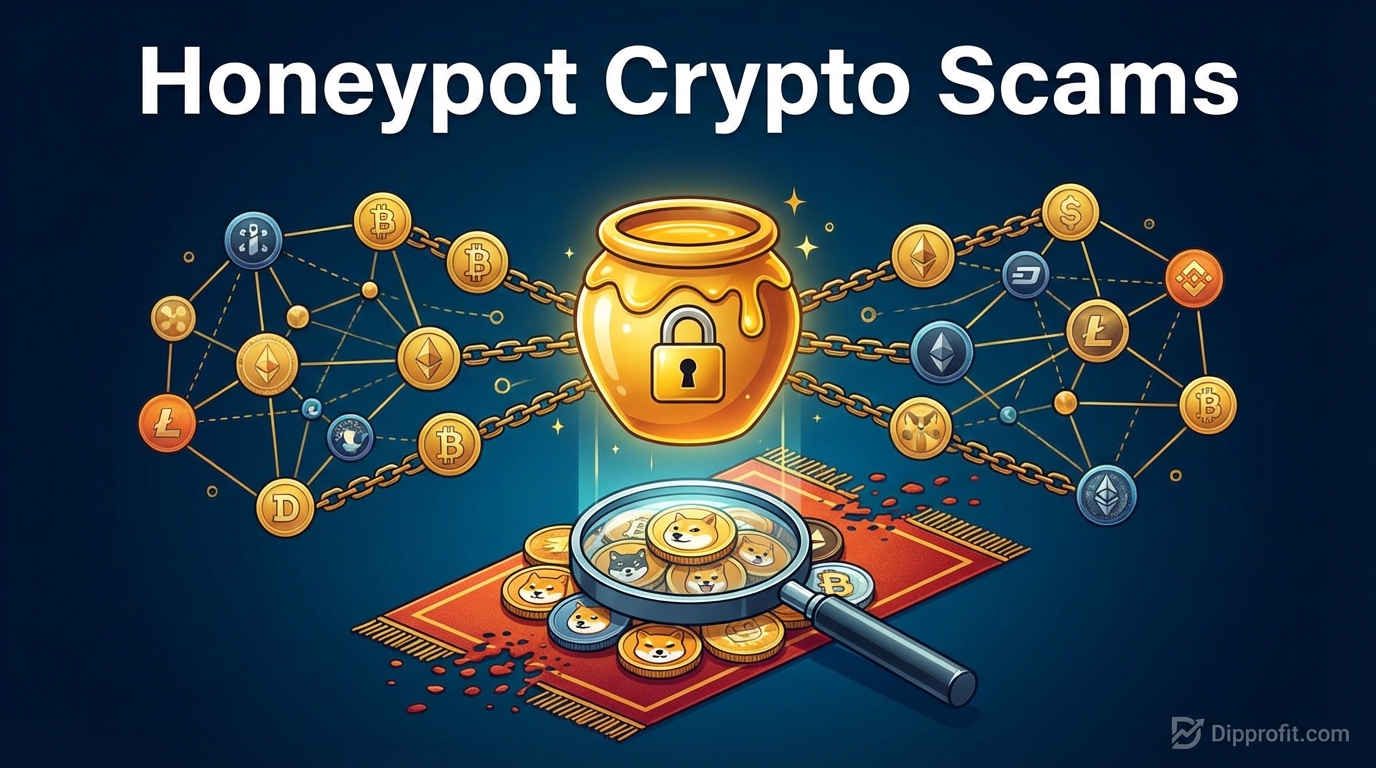

Honeypot Crypto Scam:
The Definitive Guide to Spotting Memecoin Rugpulls Before They Drain Your Wallet

| ⚠ REAL MONEY AT STAKE |
| In 2023 alone, honeypot scams and memecoin rugpulls stole an estimated $2 billion+ from retail crypto investors worldwide. SQUID token, Animex, Arbix Finance , these are not distant cautionary tales. They could happen to you on any given Tuesday afternoon. This guide exists so that they don’t. |
You’ve seen it a thousand times: A new memecoin explodes on Twitter/X. KOLs (Key Opinion Leaders) are screaming about 1,000x gains. Telegram groups are pumping. The chart looks like a vertical rocket. You ape in with $500… and within 48 hours the chart is a flatline, the dev wallet has vanished, and the token can’t be sold.
That, in plain English, is a honeypot crypto scam combined with a rugpull. Two of the most destructive and most preventable traps in all of DeFi and yet they claim thousands of victims every single day.
I have been investigating crypto fraud, tracking on-chain wallets, and analyzing tokenomics professionally for over a decade. In that time, I have personally reviewed hundreds of honeypot contracts and tracked the wallets of scammers who have stolen collective millions. What follows is everything I know translated into the practical, actionable intelligence you need to never lose money to a honeypot or rugpull again.
1. What Exactly Is a Honeypot Crypto Scam? (And Why Most People Misunderstand It)

A honeypot crypto scam is a specific type of smart contract exploit where tokens can be purchased freely but cannot be sold. The contract is coded deliberately with a hidden restriction that allows the deployer (the scammer) to sell their tokens at any time while preventing every other wallet from executing a sell transaction.

The name is perfectly chosen: the contract looks sweet, the chart looks enticing, the community looks real — but the moment you step inside, you’re trapped. Like a fly in honey. You can get in. You cannot get out.
How the Honeypot Mechanism Works — Technically Speaking
Here is what actually happens under the hood, without drowning you in Solidity code:
- The scammer deploys a token contract on Ethereum, BSC, Base, Solana, or another EVM-compatible chain. The contract code contains a hidden conditional statement — often disguised inside the _transfer() or approve() function.
- This conditional checks whether the wallet attempting to sell is the deployer’s address. If it is: sell approved. If it is not: the transaction fails usually with a generic error like ‘TRANSFER_FROM_FAILED’ or just a silent revert.
- The scammer seeds liquidity (usually $5,000–$50,000 in ETH or BNB) to make the token appear tradeable. This is called ‘the bait.’
- They then promote the token aggressively across social media. Retail buyers purchase and the price pumps because sell pressure doesn’t exist (nobody can sell but the deployer).
- When the deployer feels the pool is fat enough, they drain the liquidity, sell their allocation, and disappear. Total time: often under 24 hours.
| IMPORTANT DISTINCTION |
| A honeypot and a rugpull are NOT the same thing, although they often occur together. A HONEYPOT specifically refers to a contract that prevents selling. A RUGPULL is the act of draining liquidity or abandoning a project. You can have a rugpull without a honeypot (devs pull liquidity but selling was always technically possible). You can also have a honeypot that never rugpulls — instead the scammer simply lets the trapped buyers’ capital sit worthless forever. |
2. What Is a Memecoin Rugpull? The Anatomy of a Heist

A memecoin rugpull is the deliberate abandonment of a project — accompanied by the theft of its liquidity — by the development team. The term comes from the phrase ‘pulling the rug out from under someone.’ One moment you’re standing on solid ground; the next, there’s nothing beneath your feet.
Rugpulls come in three primary forms:
| Rugpull Type | Mechanism | Speed | Recovery Possible? |
| Hard Rug | Dev drains entire liquidity pool in one transaction. Token immediately goes to $0. | Instant (seconds) | Never — 100% loss |
| Soft Rug / Slow Rug | Dev slowly sells their allocation over days/weeks, depressing price gradually. Team goes quiet. | Days to weeks | Rarely — 80–99% loss typical |
| Exit Scam | Team raises funds (presale, IDO, NFT mint), then disappears before delivering anything. | Varies (days–months) | Never if funds already moved |
| Liquidity Migration Scam | Team announces ‘V2 migration,’ convinces users to swap tokens — and drains the V2 pool. | Days | Never — deliberate deception |
The vast majority of memecoins that rugpull do so through the hard rug — because it is the fastest, cleanest exit. A developer who has set up a honeypot contract + a large personal allocation simply waits for liquidity to peak, then executes a single transaction that empties the pool and sells their tokens simultaneously. The whole operation can be scripted and automated.
3. The 12 Undeniable Red Flags of a Honeypot Token

Over years of on-chain investigation, I have identified 12 warning signs that — alone or in combination — reliably predict a honeypot contract. Learn these. Tattoo them on the inside of your eyelids if you have to.
🚩 Red Flag #1: The Contract Source Code Is Not Verified
Legitimate projects verify their smart contract source code on Etherscan, BscScan, or BaseScan. Unverified code means you cannot read what the contract does. Scammers rely on this opacity to hide the sell restriction. If the code isn’t verified and public: walk away immediately. This is non-negotiable.
🚩 Red Flag #2: No Third-Party Audit
Any project asking you to put real money in should have been audited by a reputable firm: CertiK, PeckShield, Hacken, Solidproof, or similar. An ‘audit’ from an unknown ‘AuditedTokens.xyz’ website that appeared last week is worse than no audit — it’s manufactured trust.
🚩 Red Flag #3: 100% or Near-100% Buy Tax / Abnormal Tax Structure
Legitimate tokens rarely exceed a 5–10% total buy/sell tax. When you check a token on DEXScreener or Honeypot.is and the sell tax shows as 99% or ‘undefined’ — that IS the honeypot mechanism. The tax is so high it makes selling economically impossible.
🚩 Red Flag #4: Liquidity Is Not Locked
Unlocked liquidity means the developer can remove it at any second. Use DexTools or Team Finance to check. Liquidity should be locked for a minimum of 6–12 months via a reputable locker. No lock = no protection.
🚩 Red Flag #5: One Wallet Holds >20% of Total Supply
Check the token holders on Etherscan or BscScan. If the top 1–3 wallets collectively own 40%+ of the supply and they are not verifiably burn addresses or locked contracts, you are looking at a pre-positioned dump. These wallets will sell into every pump.
🚩 Red Flag #6: Deployer Wallet Has No Prior Transaction History
Fresh wallets (zero previous transactions, created 24–72 hours before the token) are a signature move of serial scammers who rotate identities. A legitimate team has a development history. Check the deployer wallet on the block explorer. If it was created the day before the launch: massive red flag.
🚩 Red Flag #7: The Honeypot.is Simulation Shows Sell Failure
Tools like Honeypot.is simulate a buy and sell transaction on the token before you spend real money. If the simulation returns ‘Cannot Sell’ or ‘Sell Tax: 99%’ — the contract is a confirmed honeypot. This check takes 30 seconds. Do it every single time.
🚩 Red Flag #8: No Real Sell Transactions in the Chart History
Open the token on DEXScreener. Toggle to ‘Trades’ view. A healthy token has a roughly balanced ratio of buys and sells. If you see 500 buy transactions and only 2–3 sell transactions — that is not organic. That is a honeypot where nobody can sell.
🚩 Red Flag #9: Team Is Fully Anonymous With No Accountability
Anonymous teams alone are not scams — Satoshi Nakamoto was anonymous. But anonymous + unaudited + unlocked liquidity + no prior project history = a recipe for a rug. Doxxed teams are accountable. Anonymous teams with no history are not.
🚩 Red Flag #10: Copy-Paste Website With No Original Content
Scam memecoins typically use a template website built in 24 hours. Check the website’s creation date on whois.domaintools.com. If the domain was registered 1–3 days before the token launched and the website looks like every other memecoin site you’ve seen — it probably is.
🚩 Red Flag #11: Whitepaper Is Vague, Plagiarized, or Nonexistent
A whitepaper that says ‘We will build a revolutionary ecosystem that empowers the community’ — without a single technical detail — is a placeholder designed to look legitimate. Run the whitepaper through a plagiarism checker (Copyscape). Scammers frequently copy-paste whitepapers from legitimate projects.
🚩 Red Flag #12: Suspicious Contract Functions: Owner Can Mint, Pause, or Blacklist
Read the contract (or use TokenSniffer/GoPlus to analyze it automatically). Dangerous functions include: mint() with no cap (owner can create unlimited tokens and dump), pause() (owner can freeze all transfers), blacklist() (owner can prevent specific wallets from selling — targeting YOU). These functions are the technical infrastructure of a rug.
4. The 10 Red Flags of a Memecoin That Will Rugpull

Rugpulls are sometimes harder to spot than honeypots because the contract may be perfectly functional — the fraud is in the team’s intent, not the code. These are the behavioral and structural warning signs that separate a legitimate memecoin from a pre-planned heist:
| Red Flag | What to Look For | Risk Level |
| Presale raised; no product delivered | Team raises ETH/BNB in a presale, then delays the launch indefinitely or cancels. Funds already moved. | CRITICAL |
| Dev wallet selling in stages | On-chain data shows deployer wallet making regular small sells. ‘Slow rug’ in progress. | HIGH |
| Telegram admin deletes questions | Legitimate admins answer hard questions. Scammers delete them and ban askers. | HIGH |
| Sudden ‘migration to V2’ | Without legitimate technical reason, migrations are almost always a mechanism to drain liquidity. | CRITICAL |
| Influencer-only promotion | 100% of marketing is paid KOLs. No organic community discussion. A pump-and-dump orchestrated from day one. | HIGH |
| Token launch with no DEX lock announcement | Team cannot name the locker or provide a lock transaction hash. Liquidity is not actually locked. | CRITICAL |
| Smart contract ownership not renounced | Owner retains full admin power over the contract indefinitely. Can change taxes, blacklist wallets, mint tokens. | HIGH |
| Rapid liquidity removal after initial pump | Within 24–72 hours of launch, LP tokens are removed. Pool drains. Chart dies. | CRITICAL |
| No roadmap or fake milestones | Roadmap lists events that have already ‘happened’ before launch, or milestones with no verifiable progress. | MEDIUM |
| Contract deployed from known scammer address | Cross-reference the deployer address against ScamSniffer’s database and previous flagged contracts. | CRITICAL |
5. Real-World Examples: When the Rug Gets Pulled

The SQUID Token Disaster (2021) — The $3.38 Million Vanishing Act
In October 2021, a token called SQUID — allegedly inspired by Netflix’s Squid Game — launched on Binance Smart Chain. Within days it had risen from fractions of a cent to $2,861 per token — one of the fastest pumps in BSC history.
There was one problem that thousands of buyers discovered too late: SQUID tokens could not be sold. The contract had an anti-dump mechanism that required holders to earn ‘Marbles’ (a secondary token) to be eligible to sell. The Marbles were never distributed to ordinary buyers.
The developers drained the liquidity in a single transaction on November 1, 2021, stealing approximately $3.38 million. The price chart went from $2,861 to $0.0007 — a 99.99% crash — in under five minutes. The team was anonymous, the website went offline, and to this day no one has been charged.
| LESSON FROM SQUID |
| SQUID had multiple red flags: anonymous team, no audit, a suspicious ‘Marbles’ mechanic that prevented selling, celebrity-adjacent hype with no celebrity involvement, and a contract that was not publicly verified. Every single warning in Section 3 applied to SQUID. The chart pump was the trap — not the opportunity. |
Arbix Finance (2022) — The DeFi Yield Farm That Vanished Overnight
Arbix Finance presented itself as a yield optimization protocol on Binance Smart Chain, with an audited contract (or so they claimed) and significant TVL (Total Value Locked) of over $10 million. On January 4, 2022, in the early hours of the morning, the team minted 4.45 million ARBX tokens — not in the original contract — and dumped them on the market while simultaneously draining four separate liquidity pools.
Total theft: approximately $10 million. The ‘audit’ they had advertised was outdated and did not cover the minting function that was exploited. This is textbook: an audit that doesn’t cover all functions is as dangerous as no audit at all.
Animex Token (2022) — The NFT-Layer Honeypot
Animex was a BSC token that marketed itself as a play-to-earn gaming and NFT platform. It ran a presale, accumulated BNB, and delivered a functional-looking token. But the contract contained a hidden blacklist mechanism that blocked all non-deployer wallets from selling after a threshold price was reached.
Over 4,000 wallets bought ANIMEX. Approximately $6.9 million was trapped. The deployer sold their entire allocation in 27 minutes once the price peaked. The Telegram group was deleted. The website went down. Four thousand people were left holding tokens they could not sell — not because of market conditions, but because the contract was designed that way from day one.
6. On-Chain Detective Work: The Tools That Expose Scams Before You Buy

You don’t need a PhD in computer science to investigate a token before you buy. The following tools are free, fast, and between them cover virtually every angle of attack scammers use:
| Tool | What It Does | Best For | URL |
| Honeypot.is | Simulates a buy + sell on the token contract. Returns sell tax, buy tax, and whether the token is a honeypot. | Immediate honeypot detection | honeypot.is |
| TokenSniffer | Automated smart contract audit: checks for ownership functions, blacklists, minting, proxy contracts. | Contract risk scoring | tokensniffer.com |
| GoPlus Security API | Comprehensive token risk API: checks 30+ risk dimensions including liquidity lock, holder concentration, hidden fees. | Deep technical analysis | gopluslabs.io |
| DEXScreener | Real-time chart + trade data. Shows buy/sell ratio, liquidity depth, LP lock status, deployer activity. | Chart and trade analysis | dexscreener.com |
| DexTools | On-chain analytics, liquidity lock verification, token audit scores, big transaction alerts. | Liquidity and holder analysis | dextools.io |
| Etherscan / BscScan | Block explorer. Read raw contract code, check holder distribution, trace deployer wallet history. | Contract reading and wallet tracing | etherscan.io / bscscan.com |
| ScamSniffer | Community-maintained database of known scam contracts, phishing sites, and malicious wallets. | Cross-referencing deployer addresses | scamsniffer.io |
| Team Finance / Unicrypt | Verify whether liquidity is genuinely locked and for how long. | LP lock verification | team.finance / unicrypt.network |
| De.Fi Shield | Portfolio scanner that alerts you if any approved contracts pose a risk to your wallet. | Wallet security and approval management | de.fi |
| Bubble Maps | Visualizes token holder connections — reveals coordinated wallet clusters (bots, insider groups). | Sybil and insider distribution detection | bubblemaps.io |
The 30-Second Pre-Buy Check (Do This Every Single Time)
- Copy the token contract address from the official source (never from a Telegram message or random tweet — this is how phishing addresses are distributed).
- Paste it into Honeypot.is. If it returns any sell restriction or 99%+ sell tax: stop. Do not buy.
- Paste it into TokenSniffer. Check the audit score. Any score below 60/100 warrants deep investigation.
- Open it in DEXScreener. Check: Is liquidity locked? What is the buy/sell ratio? How old is the liquidity pool? Are there whale wallets?
- Check the deployer address on Etherscan/BscScan. Is it a fresh wallet? Has it deployed other contracts? Have those contracts been flagged?
- Check Bubblemaps for the token. If the top holders are a cluster of interconnected wallets with no separation, those are insider/bot wallets that will dump on you.
7. The Tokenomics Trap: Reading Supply Distribution Like a Professional

Tokenomics — the economic design of a token — is one of the most reliable indicators of a scam. Legitimate projects design tokenomics to sustain long-term value. Scam projects design tokenomics to maximize the deployer’s exit profit.
The Concentration Test
Open the token on BscScan or Etherscan. Click ‘Holders.’ Study the top 20 holders. Here’s what healthy vs. dangerous looks like:
| DANGER SIGNS | HEALTHY SIGNS |
| Top 1 wallet holds >25% of supply | No single wallet holds >5% (excluding burn address) |
| Top 3 wallets hold >50% collectively | Supply spread across 1,000+ unique holders within 24h |
| Deployer wallet still holds tokens | Deployer wallet shows 0% or has sent tokens to verified locks |
| Multiple wallets with identical small holdings (bot pattern) | Organic distribution — varied holding sizes across wallets |
| Large holders have 0 prior transaction history | Top holders have activity history consistent with real investors |
| Tokens in ‘dead’ wallets that can be resurrected | Burn wallet is a verified, irrecoverable address (0x000…dEaD) |
The Vesting Red Flag
Legitimate projects that allocate tokens to the team implement vesting schedules — meaning the team cannot sell their allocation for a defined period (6–24 months is standard). This is verifiable on-chain via a vesting contract.
Scam projects have no vesting. The deployer receives their entire allocation at launch — or even before the public sale. If a team cannot produce a verifiable vesting contract address, their tokens are primed for an immediate dump the moment price is high enough.
8. Smart Contract Audits: What They Mean and What They Don’t

The presence of an audit badge on a token’s website is not a guarantee of safety. It never has been. Understanding what audits actually cover — and what they deliberately avoid — is essential.
What a Legitimate Audit Covers
- Code logic errors and reentrancy vulnerabilities
- Integer overflow/underflow risks
- Access control misconfigurations
- Known attack vectors (flash loan attacks, front-running)
- Gas optimization issues
- Explicit warning about dangerous owner functions (mint, pause, blacklist, fee changes)
What Most Audits Do NOT Cover
- Whether the team intends to rugpull — auditors audit code, not intent
- Post-deployment changes (if the proxy contract allows upgrades, the audited code can be replaced)
- Off-chain actions (presale handling, marketing promises, team behavior)
- Whether liquidity will be maintained
- Centralization risks — an audit can confirm that the owner CAN drain liquidity and still approve the contract
| THE AUDIT PARADOX |
| Arbix Finance had an audit. It was outdated. The minting function used to steal $10M was added AFTER the audit was completed. Always check the audit date vs. the last contract deployment date. If the contract was modified after the audit, the audit is worthless. On Etherscan, check the contract’s ‘Contract Creation’ and ‘Last Modified’ timestamps. |
The Reputable Auditors You Should Trust
- CertiK — industry standard, most comprehensive, publicly searchable audit database
- PeckShield — strong track record in DeFi protocol auditing
- Hacken — focuses on economic security and tokenomics analysis
- OpenZeppelin — trusted for ERC-20 standard contracts
- Solidproof — popular for BSC ecosystem projects
If the ‘audit’ was done by a firm you have never heard of and cannot find on Google with a history of audits: it is not an audit. It is a paid stamp of approval from a fake service designed to manufacture trust. These services exist specifically to support scam projects.
9. The Social Engineering Layer: How Scammers Manufacture Trust

The technical honeypot mechanism is only half the trap. The social engineering is the other half — and in many ways it is the more dangerous half, because it targets human psychology rather than code vulnerabilities. Here is the complete playbook scammers use:
The Fake Celebrity Endorsement
A token claims Elon Musk, Vitalik Buterin, or some other prominent figure has endorsed it. The ‘endorsement’ is either AI-generated, a screenshot of an unrelated tweet with context removed, or an outright fabrication. Neither Elon Musk nor any prominent crypto figure proactively endorses random memecoins. If they claim otherwise: it’s a lie.
The Paid KOL (Key Opinion Leader) Army
The project’s entire marketing budget goes to paying crypto influencers for sponsored posts. These KOLs often disclose ‘not financial advice’ in small print. They do not investigate the projects they promote. They are paid per post — not per outcome for their audience. When you see 15 influencers all posting about the same token on the same day: that is a coordinated paid pump, not organic discovery.
The Fake Telegram Activity
A 50,000-member Telegram group that is 90% bots. Messages flood in: ‘This is going to 100x,’ ‘I just bought more,’ ‘Dev is so based.’ These are scripted by bots or a single person managing 50 accounts. Genuine community engagement includes: critical questions being answered, debates, people sharing their own analysis.
The Urgency Manufacture
The token is ‘launching in 2 hours.’ The presale closes ‘in 10 minutes.’ There are only ‘500 whitelist spots left.’ Scarcity and urgency are the enemy of due diligence. Every second you feel rushed is a second the scammer is counting on you skipping the safety checks in Section 6.
The ‘Already 10x’ FOMO Screenshot
Screenshots of massive gains circulate before you even hear about the token. These are either fabricated or cherry-picked from the initial launch minutes when early bots pump the price. By the time the screenshot reaches you, those gains are likely already the deployer’s exit profit.
The Partnership Announcement That Doesn’t Exist
Announced partnerships with major exchanges (Binance, Coinbase), blockchain projects, or corporations that are never officially confirmed by the other party. Check the official Twitter and press releases of the named partner. 99% of the time, the partnership was never agreed to.
10. The Complete Pre-Buy Protection Checklist

Print this. Screenshot it. Before you spend a single dollar on any memecoin or new DeFi token, go through this checklist in order. Passing all checks does not guarantee safety — but failing any check is a disqualifying red flag.
| # | Check | Tool | Pass Condition |
| 1 | Run honeypot simulation | Honeypot.is | No sell restriction. Sell tax under 10%. |
| 2 | Verify contract source code is public | Etherscan / BscScan | Contract code is verified and readable. |
| 3 | Check TokenSniffer score | TokenSniffer.com | Score above 70/100. No critical warnings. |
| 4 | Verify liquidity is locked | DexTools / Team Finance | LP tokens locked for minimum 6 months with verifiable proof. |
| 5 | Check deployer wallet age and history | Etherscan / BscScan | Wallet is older than 30 days and has prior legitimate activity. |
| 6 | Analyze top holder concentration | Etherscan / BscScan Holders tab | No single wallet holds >10% (excluding burn address). |
| 7 | Run GoPlus Security analysis | GoPlus.io | No owner mint function. No hidden fees. No blacklist function. |
| 8 | Check buy/sell ratio in chart | DEXScreener | Roughly balanced buys and sells over past 24 hours. |
| 9 | Verify audit exists and is current | CertiK / Hacken / PeckShield database | Audit exists, is post-launch, covers the deployed contract version. |
| 10 | Map holder connections | Bubblemaps.io | No large coordinated insider wallet clusters. |
| 11 | Check contract for owner renouncement | Etherscan (Read Contract) | Owner address is 0x0000… (ownership renounced) or a time-locked multisig. |
| 12 | Google the team / deployer address | Google + ScamSniffer | No prior scam associations. Deployer address not flagged. |
| 13 | Check website domain age | whois.domaintools.com | Domain registered more than 30 days before token launch. |
| 14 | Verify any claimed partnerships | Official partner Twitter / Press releases | Partnership is publicly confirmed by the claimed partner on their own channels. |
| 15 | Check total tax (buy + sell) | DEXScreener / TokenSniffer | Combined buy+sell tax does not exceed 15%. |
11. What to Do If You’re Already Stuck in a Honeypot

You bought the token. The chart pumped. You tried to sell. The transaction failed. Your worst fear is confirmed — you’re in a honeypot. Here is the triage protocol:
- Stop. Do not panic-buy more. Some victims double down, hoping more purchases will somehow unlock their ability to sell. They won’t. Every additional purchase is a direct donation to the scammer.
- Confirm the honeypot. Run the contract address through Honeypot.is and TokenSniffer. Get the data that confirms it. You’ll need this for any future report.
- Revoke token approvals immediately. Go to Revoke.cash and disconnect all approval permissions you have given to the token’s contract or any associated DEX router. Honeypot contracts can sometimes drain connected wallets through the approval mechanism.
- Do not send ETH/BNB to ‘unlock’ your tokens. A common secondary scam follows the honeypot: a fake ‘support’ account in the project’s Telegram or Discord will offer to ‘unlock’ your tokens for a fee of 0.1 ETH. This is a second scam layered on top of the first. There is no unlock. Your tokens are worthless.
- Report the contract. Submit the contract address to: Honeypot.is, TokenSniffer, ScamSniffer, the relevant block explorer (Etherscan/BscScan), and if the amount is significant, your local financial crimes reporting authority.
- Claim the tax loss (where applicable). In many jurisdictions, crypto losses from scams are tax-deductible as capital losses. Document everything: transaction hashes, amounts, dates. Consult a crypto-competent accountant.
- Learn the lesson without shame. Honeypot victims include Wall Street professionals, seasoned DeFi veterans, and crypto journalists. These scams are sophisticated. Document what red flags you missed, apply the checklist going forward, and do not let embarrassment stop you from warning others.
12. Frequently Asked Questions
Q: Can a token pass Honeypot.is and still rugpull?
A: Yes. Honeypot.is detects contract-level sell restrictions. A rugpull where the team simply removes liquidity (soft rug) will pass honeypot detection because selling is technically possible — right until the liquidity is gone. That is why you need the full 15-step checklist, not just one tool.
Q: Is it safe to buy a memecoin immediately after launch?
A: Buying within the first 30 minutes of any new token launch is one of the highest-risk actions in crypto. Bots front-run every new launch. The initial price is almost entirely artificial. If you insist on early entry, position size appropriately — treat it as a lottery ticket with full expectation of $0.
Q: What is a ‘slow rug’ and why is it harder to detect?
A: A slow rug occurs when the development team sells their allocation gradually over days or weeks — small enough amounts to avoid triggering panic, but consistently enough to steadily suppress the price. The chart shows a slow decay rather than a cliff. You detect it by watching the deployer wallet on-chain for outgoing sell transactions over time.
Q: Can I recover funds from a rugpull?
A: In the vast majority of cases: no. Blockchain transactions are irreversible. Scammers route funds through mixers (Tornado Cash and equivalents) and across chains to obscure the trail. Law enforcement has successfully prosecuted a small number of high-profile rug cases, but recovery of funds is rare. The Frosties NFT case (2022) is one of the few exceptions where DoJ intervention led to recovery.
Q: Is it ever safe to invest in an anonymous memecoin team?
A: It can be, with extreme due diligence. Anonymous does not automatically mean scam — Bitcoin had an anonymous creator. The question is whether the other protections exist: locked liquidity, renounced ownership, audited code, no dangerous contract functions. If all of those are in place, anonymity alone is not disqualifying. But the bar for due diligence must be higher.
Q: How do I tell a paid KOL from an organic recommendation?
A: Look for the disclosure: most jurisdictions require influencers to disclose paid promotions with tags like ‘#ad,’ ‘#sponsored,’ or ‘#partner.’ Check if the influencer has promoted multiple tokens in quick succession — that is a strong signal of a pay-for-post model. Also check if their audience is engaged (comments, shares) or just passive (likes, which are easily bought).
Q: What chains have the most honeypot scams?
A: Binance Smart Chain (BSC) historically has the highest density of honeypot and rugpull scams due to its low transaction fees and easy token deployment. Base chain and Ethereum mainnet have seen increasing activity as scammers follow liquidity. Solana has a rapidly growing scam ecosystem as memecoins have exploded there in 2023–2024.
13. Final Verdict: The Non-Negotiable Rules of Memecoin Safety
After over a decade of watching this space — investigating fraud, tracking scam wallets, reviewing hundreds of contracts, and speaking with victims — I can distill everything in this guide into five non-negotiable rules. Master these five, and you will never be a honeypot victim:
| Rule 1: If you can’t sell, you don’t own it. |
| A token you cannot sell is not an investment. It is a donation. Always verify sellability before purchase via Honeypot.is. Without this check, everything else is irrelevant. |
| Rule 2: Hype is the signal to investigate harder, not buy faster. |
| The louder the promotion, the more aggressively you should apply skepticism. Legitimate projects don’t need to manufacture urgency. Real value compounds over time — it doesn’t need a 48-hour countdown timer. |
| Rule 3: Unlocked liquidity is an invitation to steal from you. |
| If a developer can remove liquidity at any time, they will — when the moment is optimal for them and worst for you. No lock, no buy. This is the hardest rule but the most protective one. |
| Rule 4: Position size like you expect to lose everything. |
| For any memecoin — even one that passes every check in this guide — position appropriately. I have a personal rule: no single memecoin position exceeds 1–2% of my total portfolio. That way, even a total loss is a learning cost, not a life-changing setback. |
| Rule 5: The 30-second check is not optional. |
| Thirty seconds on Honeypot.is and TokenSniffer is the minimum viable due diligence. Skipping it once because you’re ‘in a hurry’ is how you lose $500 in an afternoon. Make it a reflex. Make it non-negotiable. Make it automatic. |
The memecoin space is one of the most exciting and most dangerous frontiers in financial history. The potential for outsized gains is real — but so is the potential for total, permanent, no-recourse loss. The scammers operating in this space are sophisticated, well-resourced, and motivated by one thing: extracting your money as efficiently as possible.
The knowledge in this guide is your equalizer. On-chain data is public and permanent. Smart contracts are readable. Scam patterns are documented. The information advantage that scammers rely on is not a secret — it is just unfamiliarity. And unfamiliarity is something you fix exactly once.
You have fixed it. Now go trade — but trade smart.
RELATED ARTICLES
3 Ways to Spot and Avoid Crypto Scams in 2024
Crypto Scams Recovery Using a Cryptocurrency Investigator
If you’re reading this, you’re already ahead. Stay there, by joining the…
Dipprofit private Telegram community
Discover more from Dipprofit
Subscribe to get the latest posts sent to your email.